
 After the 10th stage of the Tour de France, Lance Armstrong sits in third place. Amazing. What an athlete. The Tour de France has to be one of the most grueling events in competitive athletics and he continues to put himself in a position to win in that legendary bicycle Race to the Top…
Now that has a ring to it: “The race to the top.” And evidently President Obama and Education Secretary Arne Duncan think so too. In fact, they have set aside BILLIONS of federal dollars as part of a stimulus package to encourage states to “race to the top” in school reform.
At this point in the race, however, we don’t have many details. For example, no one seems to know what the rules are for the race or where exactly the “top” is. There definitely is a “Race to the Top Fund” that is a component of the $787 billion American Recovery and Reinvestment Act that Congress approved in February, but there are no guidelines to tell you when you win or when you lose or even when you can climb off your freakin bicycle and have a cold gatorade.
 Pundits seem to think there are some clues in Duncan-speeches that suggest that the states on the inside track in this epic Race to the Top are those who 1) are committed to improving low performing schools; 2) states that are lifting caps on charter schools; 3) states that are big on improving teacher quality; 4) states that are moving their data systems into the 21st century, and 5) states that are on board with the whole “national academic standards” drive.
Given that description, states that are in the back of the pack about a small French village away from the leader group, include:
• Alaska, Missouri, South Carolina, and Texas—because they don’t want to play the national standards game.
• Indiana and Maine because they are considered “unfriendly” to charter schools. Shame on them.
• California, New York, and Wisconsin who are all guilty of constructing “firewalls” between student and teacher data.
• Illinois because, in general, their school system (even under the leadership of Arne Duncan) just suck.
The current leaders… that is, those who are vying with Lance Armstrong for the yellow jersey include: Colorado, Florida, Massachusetts, and Louisiana. (Nearly 70% of the schools that re-opened in New Orleans after Katrina are charter schools!)
 So I wonder… as the facts and the details of the Race for the Top Fund come to light, what kind of pressures will individual states bring to bear on their schools? California is facing a $26.5 billion deficit and while the federal money won’t bridge that gap, it would certainly encourage re-investment into the system. It would suggest we are headed down (or up) some positive path and maybe that we have a half a clue of how to catch up with the race leaders and sprint to the finish.
I wonder if Arne Duncan is prepared for the kind of innovation that the lure of $5 billion can buy.
Billions of dollars on the table. Bragging rights. A poorly fitting yellow jersey that nevertheless looks pretty nice on the cover of Sports Illustrated. New standards and expectations.
I suspect that high stakes testing is about to get higher stakes.


 Meanwhile, I noticed that the state of California still doesn’t have a budget agreement and that there is now a $26.3 billion deficit! The system is broke and it doesn’t appear that we are even
  As a matter of fact, I notice that the further away you get from actual classrooms where children and teacher live every day, the more delusional leadership becomes– like dancing in front of funhouse mirrors.

 In fact I wondered if they had found the Holy Grail. I wondered if maybe my ideas about insuring that kids mastered the standards before they moved to the next grade level… might be a little draconian; maybe even unnecessary.
 I read that they have, by design, no lab equipment, no computers, no televisions, no games at PE. They mock multicultural curricula (“the demagoguery of tolerance”) and reject efforts to build children’s self esteem. It shows. The director refers to students of color as “darkies”!

 The API is California’s Academic Performance Index. It is a long and tortured statistical calculation that synthesizes each school’s test results into a 3-digit number. Every student at every grade and every subject area is calculated and “processed” like an elegant wood chipper that grinds otherwise healthy leaves and limbs into useful chips. It weighs the number of students that score proficient and reflects overall organizational growth from year to year. Every school in California is obligated to somehow reach the API promised land of 800 or face the fate of the mastodons.
 “
“ “And we know that if 50% of our students– especially 50% of our English language learners– don’t score proficient on the California Standards Test we will miss the AYP benchmark for the first time and we will go into Program Improvement. We know that. We are climbing a mountain. So we added a full hour to the instructional day and tried to target students who were borderline. And every teacher provided English Language Development to every student for :35 minutes every single day. Damn… that has to count for something!”

 Maureen asked: “Is it LEGAL to group kids for instruction– and eventually assign them a standardized test– according to their proficiency levels?” and “Is it ethical?”
 Jonathan noted: “There are a lot of ways to demonstrate mastery of state standards other than by a standardized test. Are you giving the CST too much credibility as the main determiner of students moving forward? Are there other ways kids can demonstrate mastery of the state standards?”

 So what if we organized our students for instruction according to the martial arts, mastery-based model that is thousands of years old instead of the archaic, age-driven system that we all perpetuate today?
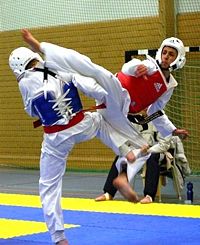 In Taekwondo and other martial arts, students are assigned a white belt until they demonstrate mastery of ALL of the techniques, blocks, kicks, forms, and philosophies that are taught at that beginning of the learning continuum. They advance through the curriculum- color belt by color belt– until they reach the level of black belt. There is a high price to pay for not mastering all of those blocking and striking techniques if you spar with another black belt so Taekwondo instructors tend to promote students only when they are ready to be promoted.
 So today I am throwing the first brick in the revolution. Right through the freaking window. Today it will be one brick. Tomorrow another. And then another. And I’ll invite you to pick up a brick or two as we get the momentum leaning our way. We are going to change El Milagro. And this blog is going to chronicle the change– the revolution– brick by brick by brick.
  It’s Week 2 of the California Standards Test and students are fingering their math facts like an abacus. Many of
 And this morning, they will each complete question number 21– a pre-algebraic word problem with one absurd possible answer choice, one answer choice that will trick a number of children who aren’t yet test-savvy enough to smell a rat, one answer choice that is correct and one answer choice that goes down smoothly…a sugar sweet placebo to remind us all that standardized, multiple-choice tests are to the disadvantage of the children that actually think. But they don’t know if they got question #21 right. They don’t know if they fell for the tricks and the traps so they cannot make mid-flight adjustments like they do on their video games. They’ll never know.
 But imagine what our teachers might do with the data if they could get it back next Tuesday. As they unwrap the tangled trends:
 It is Day 3 of the 2009 California Standards Test and it is quiet across the campus. Still. Ghost-like. Except for the traffic up on I-5 whistling like a turbine and leaning ceaselessly into the North wind. The South.
 Now we are in it. And that heads-down, pencil-gnawing silence of testing is mixed in with a healthy dose of celebration. Every day. Today the staff will play the 7th and 8th graders in flag football. Yesterday there was a school-wide movie, a huge game of “Capture the Flag” and a chess tournament. The day before we cranked the music up and danced on the black top. Testing time is also a celebration of learning. We equate it with the team that practices all week long for a big game on Saturday. The practice is fun… but it doesn’t compare to the rush of competing in bright uniforms against another team.






 "El Milagro Weblog"