SAY MY NAME

MORE STORIES from “Fighting For Ms. Rios”

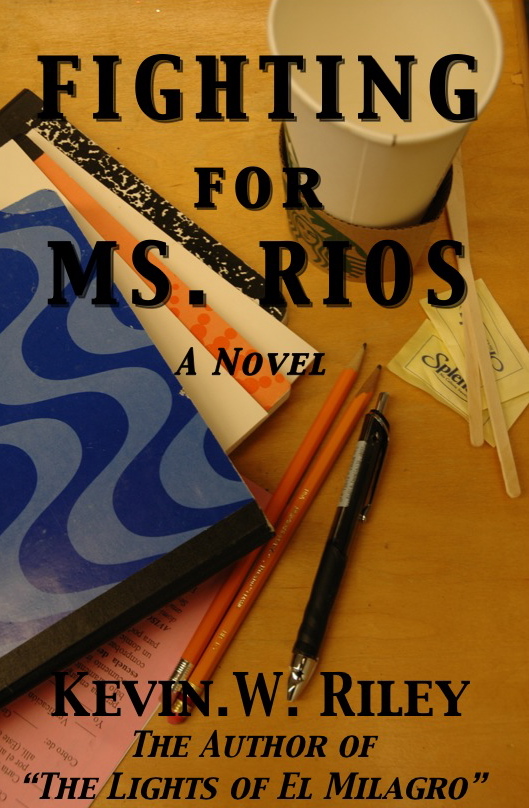
Now that my book is published and available (even for your iPad) through Amazon, I want to resurrect my blog.  There are a lot of really good posts here. So I’ll highlight different stories from Fighting for Ms. Rios and connect them back to a previous post.  It all comes full circle anyway.

BookCoverImage

Sometimes kids don’t know much… but they know the sound of their own name.  They know it’s sacred.  It gives them an identity on a crowded campus when the day-to-day grind of school life is eating them alive.

In Juvenile Hall and in the schools for our incarcerated youth that are hidden away in the back country here in San Diego, I was always pushing back on the practice of calling students only by their last name.  Like they were in the army.  Or prison.

Every kid has a first name– we call it their given name because somebody took the time give it to them.  It is so unique, it even distinguishes them from other members of their own family.  It may be common or cosmic or utter syllabic nonsense– but it is theirs– and they want us to use it.  They want us to pronounce their name correctly, too– like their moms pronounce them.  With respect and reverence.

Aiden is on to the adults who don’t know his name.

“My name is not honey, babe, baby doll, young man, sir, all star, big guy, hey you, you there, hon, sweetie, champ, kiddo, sport, new kid, mijo, laddie, buster, goofball, or dumbass.”

You can’t fake it.  You know their names or you don’t.  And knowing their names is the first step to building authentic relationships with kids you hope to teach.

 “I love the sound of my name, and though I know there are a thousand other students in my school, I want you to know how to say it.  My name is Aiden:  little fire.”

–From THE FIRST JOURNAL:  Back in Line

desk

1 Comment

Filed under Fighting for Ms. Rios, gifted children, public education, resiliency, spiritual intelligence

THE MILAGRO TRILOGY

For a while I was blogging all the time. Right here.  Some really, really good stuff.  I cranked out blog post after blog post– at least once a week– usually on Saturday mornings.  I would consistently check my stats and it looked like, depending on what I wrote, I’d have quite a few people dropping in.  Then something happened.  I got so tied up in writing and editing my second book, I couldn’t pour any more creative energy into sustaining my blog.  So I didn’t.

Now “Fighting for Ms. Rios” is complete and soon to be released.  It is a story told by a highly gifted fourth grader named Aiden who is not only an extraordinary young writer, but he is amazingly perceptive about adults and their schools. And he can fight.  Aiden writes a series of nine journals over the course of the school year, chronicling his experiences with his friends and with his remarkable first year teacher– Ms. Rios.

I had lots of people edit my book and at one point even had it placed with a publisher called Park East Press.  But I realized publishing can be a sleazy business if you get caught up with the wrong folks– and Park East Press turned out to be the wrong folks.  So I wrestled my manuscript back from them and decided instead to join the hundreds of other entrepreneurial writers and inventors and musicians and filmmakers who value their voice… and I placed my book project on Kickstarter.  Check it out.  There is even a book trailer there.

In the meantime… “Fighting for Ms. Rios” will be released on bookshelves and Kindles in September.  But that’s not all.  I’ve nearly finished a sequel called “Broken in the Middle,” where our gifted little writer, Aiden, is now in 7th grade and struggling to rise above the worst adversity that a kid will ever face.  The theme of the book is resiliency, and it is a hopeful story.

And of course there is a sequel to the sequel.  In “Catching In A Crowd” Aiden is a senior who attends a very unusual charter high school.  He is a decorated high school athlete, but the real offers are coming in from schools that specialize in creative writing.   In the final book of what has now become the Milagro Trilogy, Aiden’s journey through the K-12 system is complete.

So that’s where I’ve been.  Writing the Milagro Trilogy instead of blog posts.  But I intend to resurrect my blog, if for no other reason than to update you on the progress of the Trilogy and Aiden’s latests exploits.

Let me know what you think.

Leave a comment

Filed under California charter schools, charter schools, El Milagro, gifted children, innovation and change, public education, resiliency, teaching

GENIUS

Steve Jobs died today and I have been reading the tributes and eulogies pouring in from the very devices that he created.  I realized something as I read about him.  He lived.  He envisioned a future in which the form and function of technology could be so de-mystified that anyone could access mankind’s most promising tools.  Steven Jobs created computers that fit in our back pockets and phones that can tell us our location or divine the stock market dive or provide real-time weather updates in Jakarta or Jersey City.

The most compelling tribute came in his own words– his speech to the graduates of Stanford University in 20o5:

“Remembering that I’ll be dead soon is the most important tool I’ve ever encountered to help me make the big choices in life. Because almost everything — all external expectations, all pride, all fear of embarrassment or failure – these things just fall away in the face of death, leaving only what is truly important. Remembering that you are going to die is the best way I know to avoid the trap of thinking you have something to lose. You are already naked. There is no reason not to follow your heart. … Stay hungry. Stay foolish.”

He lived 6 more years and saw the evolution of the IPad and smarter smart phones and lots of other stuff.

Maybe in our schools we should quit debating the wisdom of using the tools and toys that Steven Jobs created and just appreciate how influential they are in ours students’ lives.  It is how they learn.  It is how they communicate.  And in fact, if it were not for Apple’s visionary instinct to link technology to public education way back in the early 1980’s, we would not have been nearly as successful in bridging the academic chasm that separates students along socio-economic lines.

History books will soon place Steve Jobs along side of the world’s greatest inventors:  Edison and Franklin and Ford and Da Vinci.  His genius made our jobs as educators easier- yet, somehow,  more urgent.

“Stay hungry,” he said.  “Stay foolish.” Then he left as if our next great genius is sitting in a classroom somewhere in America.  And of course she is.

Leave a comment

Filed under gifted children, public education, technology in schools, Uncategorized

BEYOND YOUR SCHOOL’S TATTOO

A few years ago The Journal of the American Academy of Dermatology released a study on the trend of tattooing. In it, they estimated that 24% of the population between the ages of 18 and 50 had at least one tattoo. But that was five years ago. It is likely much higher now.

And the most popular tattoo? It is the tribal band, a sun or butterfly, or some Chinese script that one can only hope means what you think it means when you commit to wearing it for the rest of your life.

A tattoo is all about commitment and communicating your “brand”.

So I wonder why our parents and our teachers don’t routinely get tattoos of our school logo. Come to think of it, I see all kinds of tattoos every day at my school, but I have never seen even one that promotes our brand.

That’s troubling. Not because I want to see a bunch of tattoo designs of our school, but because tattoos are the the ultimate expression of a customer’s faithfulness to a product. The single most powerful indicator of customer loyalty is when clients willingly share their positive experience with family and friends and urge them to see for themselves. It is the concept of “net promoter”.

And how do citizens of a capitalist and democratic society express their product loyalty? Through their frequent patronage. By word of mouth. By wearing a tee shirt (Hard Rock Cafe-London?) Through Twitter and Yelp and Facebook.

And by affiliating oneself to an idea… symbolically captured in a tattooed brand: the mercedes benz hood logo, the channel interlocking “c’s”, the nike swoosh, the flirtive persona of the playboy bunny, the venerable “NY” of the New York Yankees.

If you were to Google tattoo designs for Harley Davidson you would find pages and pages of them and no shortage of examples carved into every conceivable body part. It is a small price to pay for attaching oneself to the notion of raw power, independence and engineering excellence. Tattoos are, among other things, metaphoric.

If you Google tattoo designs for your school, on the other hand, chances are you won’t find any. You won’t find my school either and that’s the problem. Our stakeholders would sooner ink images of automobiles or household appliances or tobasco sauce to their forearms than their neighborhood school.

There may be some reasons for that:

• Product brands are familiar and reliable and often represent an attribute that an individual is willing to “advertise” for the rest of his or her life. It is less about the product and more about the metaphor. And our schools don’t make good life-long metaphors.

• When schools do show up as tattoos they are logos for universities like USC or Notre Dame or the bright red “A” of the Crimson Tide. But don’t be mistaken. These tattoos are not in tribute to the math department or to the fine services rendered over in accounting. They represent football teams that win more than they lose. Teams with history and swagger. We all like a winner. The Trojans may be on probation but they certainly aren’t in Program Improvement.

• Perhaps most importantly, if someone is willing to tattoo the icon of a business or product to their body, it is because that brand is incontrovertible and well defined. There is no going back. There is, for example, no debate about who (or what) the Apple or Target icons represent.

The neighborhood elementary school? That’s a different story.

But if people have a positive enough experience in the marketplace, if they are so passionate about a product that they feel it in their bones, if they are willing to shout from the rooftops, to at least buy the (Ferrari) tee shirt until they can afford the car– then you have a brand that works.

And if people are willing to compromise their career aspirations for a visible tattoo, to endure the stinging pain and fuss with the healing process, to brook the criticism from mom and the in-laws, to say nothing of their jealous friends’ incessant chiding–it is only because they believe so deeply in what that brand represents.

And, sadly, that is why there aren’t a lot of public schools represented in tattoos. Neither for metaphoric value. Nor for the sake of sentiment.

When it comes to our experience in public schools, there simply is no “brand” identity that invokes the kind of passion required to allow some 19 year old to carve a Chevy monster truck with Bridgestone tires into your ribcage. We forfeited that responsibility to the marketing genius of politicians who chose instead to brand public schools in a far less generous light: as ineffective, archaic, moribund sinkholes that waste taxpayer dollars.

Time for a different brand. Time to promote the extraordinary capacity of teachers and schools to not only engender amazing academic results in whatever test you want to gives us… but to simultaneously prepare students for a future that they will actually inherit– one that will no doubt require them to think, create, innovate, problem solve, communicate (in multiple languages) and work effectively with others.

What would that brand look like? And would you be willing to tattoo the icon to your body if it all lead to extraordinary results?

(This post also appears on LeaderTalk)

Leave a comment

Filed under charter schools, El Milagro, innovation and change, public education, school reform, teaching

HOPE, TITLE IX, AND THE QUEST FOR A WORLD CUP TITLE

It never really occurred to me that the U.S. would lose to Japan in the World Cup Soccer Final last Sunday.  Our women’s team was magical.  They came from behind against Brazil and won on penalty kicks and the rest seemed pre-ordained.  All that was missing was Al Michaels roaring into the microphone: “Do you believe in miracles?!!!”  and the jingoistic chant of “USA!…USA!…USA!…”.

So I decided I would write a post about the amazing skill and passion and audacity and focus and persistence and fitness and resilience and talent of this extraordinary team.  I decided I would write about how they flew to Germany and somehow captured the heart of a nation back home.  How, while most of us were bellyaching about the NFL lock-out, our girls were quietly kicking butt.  How they lifted one of the most coveted trophies in international sports: the World Cup.

But then they lost.  Japan came from behind and won on penalty kicks and the tables were turned.

So much for my blog post about winning the World Cup.

Then I noticed something else about our team. I saw how incredibly positive they were– how gracious, even in the face of heartbreak and defeat.  There were no tears.   There was no scape-goating or drama.  Just classy American athletes at a time when “classy” and “American athletes” have long since become an oxymoron.

That’s when I realized that we are all beneficiaries of Title IX.

That 1972 federal law which created new opportunities for women in athletics was based on the Equal Protection Clause of the 14th Amendment.  (Incidentally, so was the line of cases and laws that defined student rights in special education, school finance schemes, bilingual education, and of course, school desegregation).

“No person in the United States shall, on the basis of sex, be excluded from participation in, be denied the benefits of, or be subject to discrimination under any education program or activities receiving Federal financial assistance.”

Title IX represented a vision of opportunity and equal treatment that has, forty years later, inspired our daughters to excel in every walk of life.  And not just our  daughters because many of those Japanese athletes grew up watching Mia Hamm and now play professional soccer here in the US.

Engraved in the golden walls of the World Cup is (at least metaphorically) a kind of promise– that when you provide every person with legitimate opportunities to fully develop their natural gift, the boundless potential of the entire human family comes closer to fruition.

The fight for educational equity in the United States is far from over.   There are huge populations of students “left behind” in the achievement chasm.  There are also critical subgroups suffering in silence who are worthy of advocacy at least as passionate as that which produced Title IX:  namely, those who are poor, or homeless, or our gay and lesbian students, or our immigrant children, or kids who are victims of bullying. And now we know what happens when we let all of our kids compete.

The US Team was lead by a goalie named Hope.  That is fitting.  And she would be the first to tell us that you don’t win a world championship on hope, but rather, on focussed energy and effort and commitment.  That lesson wasn’t lost on the hundreds of thousands of young girls no doubt watching their new idols on Sunday and dreaming  of a world cup campaign of their own.

That is the legacy of Title IX which we all inherited–  a promise to our children that they can play too.  As equals. That is what makes the quest for the World Cup worthy of your journey.  And mine.

Cross-posted on LeaderTalk

Leave a comment

Filed under El Milagro, gifted children, physical fitness, public education, resiliency

THE SUMMER TRIANGLE

Our stars mock us.  I realized that this morning when I read about the Summer Triangle which will appear tonight in the eastern sky just after dark.

There are three stars in the Summer Triangle and while they appear to look the same… they are not even in the same constellation.  Altair is 17 light years away.   That means, in the parlance of astronomers, that the photons of light that strike our eyes tonight actually left their source back in 1994.  Seven years before No Child Left Behind launched our present preoccupation with accountability (and the madness of interminable testing)… Altair issued light.

Vega is some 150 trillion miles away and it’s light left 25 years ago—just after A Nation at Risk called out our schools for their extraordinary mediocrity.  It is also the year that President Reagan decided that he would honor teachers by sending one up on the space shuttle.  We all regretted that decision:

“…they slipped the surly bonds of Earth to touch the face of God”

On the final vertex of the Summer Triangle sits Deneb.  At a distance of 9,000 trillion miles, we are seeing light that has actually been traveling through space since the 6th century.  And yet when we look at Deneb, the untrained eye will merely see a twinkle… and wish upon a star.

So here’s the point.

For decades we have been in search of stars.   We call them “exemplary” schools, “break-the-mold” schools, “distinguished” schools, “blue ribbon” schools, “award wining” schools.  We mine them for their essence and too often discover one disappointing commonality:  their commonality.

I wonder which “stars” you follow.  I wonder whose light you take your inspiration from.  I wonder why there are so many stars flickering and fading in the cosmic panorama of public education— like heavenly bodies whose light is owed to the by-gone genius of some other era.  Like 1994.  Or 1986.  Or 1886.  Or the 6th century.

Stars are not as they appear.  They are inspired by old and even ancient energy.  They are romanticized and gazed upon and dreamers set their sails by them.  But while they are universally regarded as a metaphor for excellence; for champions and models and promising performers and the best of the best– they are quite literally, a portal to our past.

My charter school is in perpetual orbit in search of new and different results.  There are at least three constants:  our kids keep coming, every one is unique and different, and we can’t live on your star.  We survive on our wits and creativity and courage to change.  On leaning forward.

In “The Myths of Innovation”, Scott Berkun writes  “By idolizing those whom we honor we do a disservice both to them and to ourselves… we fail to recognize that we could go and do likewise.”

Like right now. In the next few stress free weeks– in the shower or kayaking or stargazing on a summer break—fresh ideas will incubate.  We will find our own inspiration.  Our own solutions.

So tonight I am going out to look for the Summer Triangle just because I talked about it here.  (Without my Pocket Universe Ap I won’t be able to tell Deneb from Vega and all their light will look the same.)  I’ll admire its symmetry, but not its wisdom.  The rest is up to me.

“It is an achievement to find a great idea,” writes Berkun.  “But it is a greater one to successfully use it to improve the world.”

(Cross Posted on Leadertalk)

Leave a comment

Filed under California charter schools, El Milagro, innovation and change

A GENERAL’S LAMENT

Now I am conflicted.

Usually when some CEO from a dysfunctional industry shares his or her insights on how I can better do my job as an educator, it is easy to dismiss.  Is serving in Congress really all the experience you need to become an authority on educating children?  Or is running a computer start-up sufficient enough to make one an expert in the nuances of pedagogy?  Or is joining the Rotary Club?  Or having your own kids?  Or coaching a little league team?  Or managing a fast food outlet? Is not being an educator  really all it takes to know what ails the public education system?  Really?

I think educating another human being is far more complex a process than dentistry… but when it comes to root canals I’m more than willing to defer to my dentist, Dr. Disraeli.  I have a healthy regard for his expertise.

And yet, for whatever reason, EVERYBODY is an expert on what is wrong with our schools and what we should do to fix them. So I really was conflicted on Sunday morning when I read an editorial by James Comstock, a retired Army Major General who is the latest non-expert expert to weigh in on how screwed up our schools are.  His is a little different take.  He wrote:

“A report by the nonprofit Mission: Readiness estimates that 75% of young Americans are not able to join the military and one of the leading reasons is a failure in our education system.”

The Major General cites the current high school drop out rates, the high percentage of physically unfit kids, and the incidence of juvenile crime as deal breakers for individuals who might otherwise want to join the all-volunteer armed forces.  And they are.  These are the trends that every community must address through a combined effort of public policy, law enforcement, health care, social services, fitness, recreation and business. And yes, education services—from Pre-K to the university.

But not having enough enlisted recruits to slake the military’s thirst for perpetual war is not what keeps me awake at night.

It’s not that I’m unpatriotic or that I don’t appreciate the military service of my father and my two older brothers and the millions of other American veterans.  I am.  That’s why I am conflicted.  I want our students to be academically qualified for West Point (or USC)– not necessarily to enlist in the army.  So I did some research about who really does join the armed forces.  I was pleasantly surprised.  I learned that:

• Members of the all-volunteer military are significantly more likely to come from high-income neighborhoods than from low-income neighborhoods.

• Only 11 percent of enlisted recruits in 2007 came from the poorest one-fifth (quintile) of neighborhoods, while 25 per­cent came from the wealthiest quintile.

• American soldiers are more educated than their peers. A little more than 1 percent of enlisted personnel lack a high school degree, compared to 21 percent of men 18–24 years old, and 95 percent of officer accessions have at least a bachelor’s degree.

• Contrary to conventional wisdom, minorities are not overrepresented in military service. • Enlisted troops are somewhat more likely to be white or black than their non-military peers.

• Whites are proportionately represented in the officer corps, and blacks are overrepresented, but their rate of overrepresentation has declined each year from 2004 to 2007.

Evidently the military is actually meeting its recruiting quotas with quality folks who are drawn—no doubt—from the public school system.  We must be doing something right if it is our alumni who are fighting the general’s war. If you ask me the purpose of public education is in the United States today— or what legacy I might one day leave behind in my leadership of public schools— I honestly would not list feeding the military pipeline as one of my accomplishments. I am not striving to close the achievement gap as a patriotic gesture.

“America’s military strength depends on its young people,” says the Major General.    “Encouraging physical fitness in schools and providing children with the quality education they deserve will help insure our national security for years to come.”

It turns out Major General Comstock isn’t the only high-ranking officer who wants schools to do better in the interest of maintaining our military supremecy.  Former Chairmen of the Joint Chiefs of Staff, Generals Shalikashvili and Shelton stated that “investing in our children through early education is a plain common sense issue critical to our National Security.”

Indeed.

But I’d like to believe– however naïve it may sound– that the more advanced and effective our educational system becomes, the more equitable the opportunities we provide for our students, the more just our society, the more civil and fair and moral our nation… the less we would have need for a military at all.

I still sit in awe of the extraordinary courage displayed by Patrick Tillman when he abandoned a multi-million dollar NFL contract to join the Major General’s army for a soldier’s salary. Brilliant.  Beautiful.  Athletic.  Young.  Patriotic.  The very, very best of America’s youth.  Killed by friendly fire and then buried in bureaucratic lies.

I wonder what would the army would do if our public schools produced more children of the quality of Patrick Tillman.  Until that is resolved, maybe we strive to prepare children to change the world in their own way, to be all they can be, and manage our own conflicting feelings about patriotism, and the “failures of the public school system”, and the supposed dearth of soldiers qualified to execute a war.

Simultaneously posted on Leadertalk

Leave a comment

Filed under Uncategorized

SAVING SIR KEN

Lately I have been thinking about Spielberg’s movie “Saving Private Ryan”.  Not because we just celebrated Veteran’s Day or because I am particularly inspired by war movies, but because I have been researching models for effective teacher leadership.  And not-so effective models, too.  And because, for a moment there, we lost sight of our mission, just like Captain Miller’s troops.

It happened yesterday when my staff watched Sir Ken Robinson’s video clip on the relative zaniness of the American public education system. We all seem to share a common loathing for standardized tests and what they do to our teaching.  The absence of science and physical education and critical thinking and poetry and joy is conspicuous in our efforts to meet this year’s version of the AYP.  There is deep stress in that.

Moreover, we are healing from a self inflicted (though well-intentioned) wound since we expanded from seven multi-age classrooms to 21 in one year.  Our teachers are struggling.  Searching for support.  Venting. Identifying their frustrations and cursing our commitment to innovation.  And cursing me for promoting the idea in the first place.  Fair enough.

But in the emotions of the moment during our weekly staff meeting when all of our teachers’ patience was at the boiling point, we all forgot that our school is driven by a mission.  Eleven years ago we vowed to get 90% of our students to grade level. At the time, only 19% were there.  That was considered par for our demographics- a low income school 7 miles from the border to Tijuana. But we knew that our students and families and teachers were better than that.  We knew our students had it in them.  We knew our kids would be saddled by low expectations for the rest of their lives unless we changed the culture of achievement at our school and throughout our community.  And so we did.  And now 70% are proficient…and climbing.

Our mission is decent and worthy.  We are not inspired by NCLB or the superintendent or the fear of being labeled an underperforming school.  We are driven, purely, by the boundless potential of our students.

So we promote authentic teacher leadership and democratic models of decision making because we believe that that is the pathway to achieving our goals.  It is the way in which we will get that final 20% proficient.  There is no other roadmap.  No one person has the “right answer’ so we count on all of our teachers to share their expertise for the good of the whole.  It just seems like lately we have gotten distracted by the challenges of implementing  large scale change and we have lost our acuity for identifying the alternative tactics and strategies necessary to move forward.  It is killing morale.  It is testing our resolve.

In the end I am sure Sir Ken Robinson is right and we are all complicit in the destruction of America’s system of public education because we defer to the standardized test.  But that is the game we are in.  That’s the deal. Even when the troops are restless. Sometimes leadership is pointing the compass back to “true north” and holding on to the rudder for all you are worth.

There is a scene in “Saving Private Ryan where Captain Miller’s battalion disintegrates into a dangerous rabble of griping hot heads armed to the teeth and threatening to shoot each other. They had had enough of ‘the mission’.  But he stood his ground in the midst of the chaos. He was calm and decisive.  And for the sake of dramatic effect and unity of purpose, he reminded them all of their lives back home.  Earlier, they had placed bets on what their captain did for a living.  Remember his answer?

He was a high school history teacher.  Mission-driven. A model of teacher leadership.

1 Comment

Filed under California charter schools, El Milagro, innovation and change, standardized testing

RAINMAKERS

I was asked by Scott McCloud to be a guest blogger on his site called “Dangerously Irrelevant”.  He invited several veteran administrator/bloggers to respond to this question:

“What do administrators expect of their teachers?”

You can find my post at Dangerously Irrelevant.  Or just read it here!

When Scott first invited me to contribute a post in response to “What Does Every Administrator Need from Teachers” I immediately thought about the “Seven Gifts of El Milagro” that I wrote about a few years ago. At Mueller Charter School (aka. “El Milagro”) there just seem to be some common attributes shared by our most effective teachers. In the long grind of the school year and the relentless escalation of demands imposed by No Child Left Behind, I have come to expect these seven attributes from all of our teachers: commitment, talent, innovation, collaboration, intrinsic motivation, resiliency, and compassion.

THE GIFT OF COMMITMENT
The first of the Seven Gifts is the Gift of Commitment; an ability and willingness to focus like a red laser on the battle at hand. A belief in the cause. We look for warriors, and not just in the poetic sense of the term. True warriors are relentless in their pursuit of the mission. Even in the face of personal loss and harm, they give of themselves. No excuses. No compromise.

Trapped

THE GIFT OF TALENT
While it would be nice to place a classic and complete teacher in every classroom, we have to settle for talented and inspiring and academically curious idealists. Our teachers have to have a strong, foundation in literacy and mathematical reasoning. They have to have that content knowledge.

But math and language arts content is not enough. Nor is science, social studies, physical education, and the visual and performing arts content. In between, who will make Yo-Yo Ma as real as Beyoncé? Who will inspire children to take a second microscopic look at a cricket’s wing and marvel at the intricate similarities that exist among living things? Who will explain how the same people who gave us Babylon, now give us Hamas? Who will teach children to sing with whatever voice God gave them…if not their teacher?

At El Milagro, our teachers must first be talented human beings if they are going to be talented teachers. And talent is formed from each individual’s unique amalgam of interest and curiosity, their personalities, their life experiences, their natural gifts. And, of course, their ability to translate their excitement and love for learning to others.

THE GIFT OF INNOVATION
The grand metaphors of life do not escape the creative observer. Life, in and of itself, may very well be the metaphor. In the meantime, however, there are those whose minds can bend and accept ambiguity and change and chaos and the long rough ride. There is a flexibility in their mental constructs. They solve problems with a sense of humor. They are confident in their own efficacy.

We used to say that we were looking for people who were capable of “thinking outside the box” until thinking outside the box became its own confining metaphor. So now we are just looking for gifted innovators…people with imaginations, playful spirits, and an ability to create El Milagro from Mueller Charter School. We are looking for Picasso or George Lucas. We are looking for Andy Warhol to find something useful to do with a can of soup besides open it with a rusted kitchen tool. We are looking for Christo to drape Central Park in orange banners and photograph the tourists as they run through them—catching and consuming them as if they were snowflakes melting in their mouths for the first time.

A GIFT FOR COLLABORATION
We are not the passengers. We are the crew. We row together or die in irons. There is no option for reclusive entrepreneurs concocting innovations in the broom closet. We share. We talk. We brainstorm and ask lots of questions that begin with “What if…” Our teachers communicate about their students’ progress on a regular basis. They collaborate with anyone who wants to play. And they all want to play.

THE GIFT OF INTRINSIC MOTIVATION
We are looking for teachers who have the rare ability to find inspiration in their own magic; teachers who are driven only by a compulsion to serve. Indeed, if people are intrinsically driven to achieve greatness on behalf of others, and to be a part of a passionate force of change, there is simply no more powerful source of motivation. If we are truly committed to the success of every child…then nothing can motivate us but their success! Nothing. Not money, not fear of sanctions, nor a manager’s praise.

THE GIFT OF RESILIENCY
Our teachers have to be resilient. That’s why we seek warriors who will not take “No” for an answer. Our teachers will not be denied. They fall and they rise up. They fall and they rise up. Their resilience is as much a part of El Milagro as anything else we do. We can’t promise much. But we can promise you will stumble and swear and agonize over the challenges: the mobility, the poverty, the ambiguity. The never-ending meetings and demands when you are sick and tired and buried and when you just want to hide out in your classroom and catch your breath.

And just when you arrive at your breaking point, in that moment when you discover that you cannot succeed at El Milagro unless you are resilient…you rise yet again. Bouncing back. Modeling persistence. While children all around you notice that the mysterious strength that they are drawing from their teacher somehow carries them—and they discover in themselves the strength to overcome anything.

THE GIFT OF COMPASSION
In “A Love Poem for My Students”, Ms. Michel, one of my first grade teachers wrote of her compassion for her students.  In part, it says:

I live to learn how to teach
my young people how to reach
the stars.

By far—
they are the most blessed gift given to me.

Ms. Michel has many gifts as a teacher. But the ones that her students derive the most benefit from are her commitment… talent… innovation… collaboration… intrinsic motivation… resiliency… and compassion. The Seven Gifts.

She reminds me of the verse I once read from Exodus: “You are blessed. You are a blessing to others. You are a blessing to the world.” I suppose, in the end, that that is what I ask of teachers every day: to bring the seven gifts and be a blessing to the world.

Leave a comment

Filed under Uncategorized

SURVIVORS

Isaac got in between his mom and her boyfriend when they were fighting and caught the flying coffee pot right on the corner of his cheekbone.  Even through the stitches he refused to cry.

Andre lost his little sister when she rode her bicycle in front of the trolley.

Erica has a parent in prison.  Both of Emilio’s parents are incarcerated.  Joaquin never knew his parents.  Beto is the parent because his mom works three jobs and is still below the poverty level.

Survivors.

But teaching survivors how to add fractions or to sort between metaphors and similes or to distinguish the relative power of the three branches of government– all while their lives are falling apart around them—is almost cruel.

Then again, it is essential to the healing.  In the worst of life crises, school is often the one stable element in children’s lives.  So we go on.

But it is a lot to ask children to overcome adversity on their own.  They need the support and the structures to persevere.  So at El Milagro we build on their natural assets.  We intentionally teach them to be resilient, and in fact, to come through fire stronger than before.

We create the processes to monitor students, assess the extent of the services they need, and marshal our resources to fully support them outside of the classroom.  Some students need counseling.  Some need to be in a support group.  Some need vision screening, or a free lunch card, or a Big Brother.  Some need the intervention of child protective services.  Whatever their needs, we have the system to address it.

Recent reports that the national poverty level has worsened came as neither a surprise nor an epiphany for us.  We see the effects every day.   We find ways to mitigate against the environmental factors that make academic achievement difficult to engender. Not impossible.  Just real tough.

We have become experts in teaching children to overcome poverty; to be resilient.  Maybe that is as it should be.  But it would far better for kids if the root causes of poverty and despair where addressed in their communities; if there were real systemic solutions to unemployment, crime, neglect, and lack of health care.

If only adults were as resilient as the children they are obligated to serve.

Leave a comment

Filed under Uncategorized