Category Archives: California charter schools

JOURNALING CHAOS 1: “First Bricks”

chaosjpeg

The “I Ching” teaches that “Before there can be great brilliance… there must be chaos.”

This series of blog posts documents our research, strategic thinking, observations and debates as we take on one of the last vestiges of the industrial revolution: the practice in schools of organizing kids into grade levels according to their chronological age.  

We have been talking about school reform for as long as I can remember.  And restructuring.  Revamping. Creating distinguished schools.  Schools of excellence.  Blue ribbon schools. 90-90-90 schools. Break-the-mold schools. Effective schools. Charter schools. 

title1aaalogo1

But schools– even schools like El Milagro–  are still pretty much the same as when I went to them. And so are the results. We still have an achievement gap that separates our children’s future along the lines of race and class and home language.  We still struggle with the edicts of Sacramento and Washington, DC. We get bombarded with research studies from university professors who are among our  nation’s least effective teachers.  We push our kids and our teachers to the limits of their patience and ability and health.  We squeeze blood from a turnip.  We eek out the last 3 API points and scramble and strain to “meet our AYP goals.”  We adjust to all the latest changes in the state’s nuanced metrics and how we keep score.

And we make progress.  For a price.

This is not what educating our children should be about.  This is not teaching and learning.  It is not preparing children for the competitive rigors of the 21st century, globally interconnected, green and fragile world they are inheriting. And you know it!

And so do I.

the revolutionSo today I am throwing the first brick in the revolution.  Right through the freaking window.  Today it will be one brick.  Tomorrow another.  And then another.  And I’ll invite you to pick up a brick or two as we get the momentum leaning our way.  We are going to change El Milagro. And this blog is going to chronicle the change– the revolution– brick by brick by brick.  

I am aiming at one very traditional, very systemic, very sacrosanct structure that is creating the greatest roadblock to our forward progress.  In the parlance of the extended  war metaphor:  we are taking out a strategic bridge that has kept us constantly circling back to our beginnings.  It was the wrong bridge from the beginning but now it has been there for 150 years and it’s hard to imagine life in our schools without it.  But we’ll all get used to it.  We need a new bridge that will take us in a very new direction.  It will provide a different view of the horizon and the pathway to a very different destination.  

The bridge we are taking out?  The one that leads to the same outcomes every year?  The one that lures us into taking three  steps forward and two steps back as an annual ritual?

It is the extraordinarily resilient model of grouping children by their chronological age. 

That’s the target.  It may not seem like much right now, but if we take out that bridge a revolution in public education will spread and from the ensuing chaos… there will be the potential for great brilliance. 

Follow this blog series and you will see why.

3 Comments

Filed under California charter schools, charter schools, El Milagro, standardized testing, teaching, Un-graded schools

EL MILAGRO AT A CROSSROADS

crossroadsThis is the anniversary of my first blog.  I have now been blogging for a full year.  59 posts, 147 comments and countless hours and caloric expenditures of creative energy later… here I am.  Somewhere.

But this week I had an epiphany.  

On Thursday  I contributed a comment to Scott McLeod’s blog called Dangeously Irrevelevant, and somehow I think it got deleted.   He is a professor in Iowa and a frequent critic of public education and his own children’s schools. Blogs are good for asking challenging questions and he usually asks some tough ones.  But I took exception to this:

Does anyone think that we were doing a fine job of meeting the needs of underserved populations before ‘the tests?’ Have we all forgotten that school has been boring for generations?

It’s not ‘the tests.’ It’s our unwillingness and/or inability to do something different, something better.

It’s not ‘the tests.’ It’s us.

So whose schools are we talking about?  His kids go to school in Iowa for God’s sake– hardly the crucible for school reform.  Yet this is the kind of statement I see made all the time, especially from university professors who have little room to question the quality of instruction at the K-12 level. So I said, in effect, “I disagree.  We are doing something different at Mueller Charter School and it certainly isn’t boring.” And I cited our partnership with the Chula Vista Nature Center as an example.

Maybe citing Mueller Charter School is considered self-promotion on somebody else’s blog.

Maybe my objection was deleted because I used my own school, as I often do, as an example of a public school that works.

Maybe the critics of the K-12 system don’t like to acknowledge “isolated examples” of schools that work– even though charter schools exist to serve as innovative and sometimes “isolated examples” of courageous change. The way I see it, one example from El Milagro is as valid as criticizing the entire K-12 system on the basis of a single school in an Iowa cornfield.  

So whatever. Dangerously Irrelevant has to live up to its name.  My blog merely needs to live up to El Milagro— the miracle.

All I know is that I am investing too much time commenting and debating in this medium; I’m expending too much creative energy on trying to be a participant and build an audience for my blog.  

I have a school to run.  I have students and staff who need my creative energy to be devoted to them. I have several book projects winding their way to completion.  And we have two extraordinarily promising projects on the drawing board that could profoundly transform our school (and any other school that pays attention to our work.)  

So this is as good a reason as any to steer my blog (and my blogging) in a different direction.  I’m just going to document the transformation from Mueller Charter School into El Milagro and leave the debating to the critics on the sideline.

As for the two projects… stay tuned.

2 Comments

Filed under California charter schools, El Milagro, environmental studies, public education, teaching, Uncategorized

INSTANT ABACUS

abacusjpegIt’s Week 2 of the California Standards Test and students are fingering their math facts like an abacus.  Many of our children couldn’t wait for the math portion of the CST.  They are descendants of the Mayans and ancient astronomers of the Yucatan.  They know mathematics.  It flows through their blood in algebraic platelets and word problems with multiple right answers. 

Math is our advantage.

But these are also the children of the video game and “Guitar Hero”; the dance step and :30 second wait for an Original Dream Machine with an extra energy boost.  They call upon the internet and it responds immediately– or they will divine a better connection.

The response is immediate.  The results appear promptly.  And the sociologists decry us all as the generation(s) somehow spoiled in our expectation of instant gratification.  And they may be right.

aim

But when it comes to the standardized testing game, we receive anything but instant gratification.  In fact, we will wait three months for the results.  They will come in late July, most likely the first week after our teachers return from a brief summer nap.  By then they will already have met their new students and new colleagues and new parents.  And right about the time that they are adjusting to the idiosyncracies and learning styles and potential and challenges of a new class, last year’s data will arrive with a crash on the doorstep.  Like the morning paper thrown too hard from a passing car.  One that slams the screen door at the bottom and sends the frightened cat racing through the house with her ears pinned back.  Scared shitless.   

The test results will of course make headlines in the local section of the Union-Tribune.  There will be a complete analysis.  They will be posted school by school on the internet.  And those of us who strain every day against an odd alignment of conflicting systems, will immediately recognize that no matter how good the news or how bad the news… there is not a thing that can be done now to change our history.

Schools will go into Program Improvement.  There will be sanctions and consequences.  Administrators will be shuffled.  Teachers will be placed on assistance plans.  But none of those steps can change the outcomes from a group of children who have now come and gone.  

So if the California Standards Test is so important that it can change lives and careers and entire communities… why does it tak three months to get the results?

This is after all the age of technology.  Instant gratification.  If it is so high a priority, tell us how our students did on this morning’s math assessment… but tell us now.  I’ll even give you a week. No excuses.  I don’t want to hear how many schools there are in California and the hundreds of thousands of tests that have to be scanned or the logistics of reporting it all back or any of those other stock complaints.  When we were chided about our low API a few years ago, no one wanted to hear about our families in crisis or our children who have lived in multiple foster homes or the child attending his 22nd different school or the inherent struggles for second language learners.  The mantra of the “Age of Accountability” is “No Excuses!  So we will push our students up the mountain side in search of miraculous growth.  We will keep them whole and alive.  We will challenge and cajole and celebrate them.  And we will test them.  

testAnd this morning, they will each complete question number 21– a pre-algebraic word problem with one absurd possible answer choice, one answer choice that will trick a number of children who aren’t yet test-savvy enough to smell a rat, one answer choice that is correct and one answer choice that goes down smoothly…a sugar sweet placebo to remind us all that standardized, multiple-choice tests are to the disadvantage of the children that actually think. But they don’t know if they got question #21 right. They don’t know if they fell for the tricks and the traps so they cannot make mid-flight adjustments like they do on their video games. They’ll never know.

And by the time the results come back they won’t care!  Because kids are like that. They want to know the results right now… or heck with it.  By next July they’ll have other fish to fry.  For teachers it is a different story.  The percentage of children that tanked on #21 will be instructive.  Sort of.

giftsBut imagine what our teachers might do with the data if they could get it back next Tuesday. As they unwrap the tangled trends: 

• They could review the results with students so they know where they are strong and what areas they need to work on with 5 weeks left in this academic year.

• They could create an individualized summer learning plan for students so they could bridge some gaps in their learning before the next school year starts.

• They could meet with parents and triangulate the CST results with evidence of classroom work and other local assessments.  By then, parents would know exactly what level their children are on– their academic strengths and areas for growth.

• They could provide parents a summer reading list based on the CST lexile report.

• They could bring some closure to the school year and prepare each child’s file for transferring on to the next teacher.

• They could identify appropriate grade level placements for the next school year.

• They could meet with next year’s teacher with definitive data.

• Grade levels could re-group around the data and identify areas that need to be re-taught, or celebrated, or re-enforced, or tossed out altogether.  

• They could make informed decisions about the programs and policies and approaches and innovations that were successful and the ones that weren’t.

• They could fully capitalize on their expertise in using data to leverage informed, strategic change.

And of course we do all of these things in time.  But if the system were better aligned, and the data were returned to us, and the legislators and test bureaucrats in Sacramento had to stretch as much as we did… we would all have the tools we need when those tools would have the greatest impact.

At El Milagro we are in search of results.  Now.  Instantly.  No excuses.

gold 840

Leave a comment

Filed under California charter schools, charter schools, El Milagro, public education, standardized testing, teaching

HIGH STAKES… All IN

testsWe are two weeks from the 2009 iteration of the California Standards Test.  The clock is ticking. We are prepared.  We are in a zone.  And we better be…considering the high stakes.

High stakes?  Isn’t that just residual hyperbole left over from the NCLB-era politics?  Well let’s check it out.  

Here are a dozen ways that standardized testing has resulted  in high “stakes” outcomes and their unintended consequences:

• High stakes because the results are going to follow every student for the remainder of their school careers.

• High stakes because schools will use the results to determine students’ eligibility for after-school programs and tutoring opportunities and Advanced Placement classes and extracurricular activities. Even for eligibility (and thus in-eligibility) for participation in athletics and the performing arts.

• High stakes because school officials will use the scores as a criteria for classifying children as gifted– public education’s most coveted label.  Similarly, they will cite these scores when diagnosing children as learning disabled.

• High stakes because schools will (illegally) weigh the portents of  these scores before admitting new students.  Or they will consult them– the final straw– before expelling or disenrolling kids; before recommending ‘delinquents’  to a continuation program or independent study or homeschooling or some other version of learning in Siberia.

In high stakes testing, the results matter to everybody. 

board-mtg1

• They are “high stakes” because presidents and governors and mayors run for elected office on the promise of improving local trends in standardized test scores.  School board members too.  And the superintendents that school boards hire will survive on their ability to deliver higher scores on metrics like the Academic Performance Index (API).  Likewise the principals that the superintendents hire will come and go like bad wind and pretty much everybody will feel the pressure when the next wave of leaders are clearing out their desks and insuring their colleagues that they have always wanted to return to the classroom.  

• High stakes because that pressure to raise test scores will drive teachers with the most seniority (and experience) toward the schools with the higher API (800+) and lower stress levels. 

u-haul-1• High stakes because schools with low API’s (<700) will continue to replace those migrating veteran teachers with brand new inexperienced teachers who will take five years to learn their craft… and then they will migrate too.  And while they are learning, those younger teachers will be just starting to raise families of their own.  So you can expect those teachers to be out two to three months on maternity leave and to be temporarily replaced by long-term substitute teachers who have less training and less experience than the inexperienced young teacher they are replacing.

And the community will witness the invisible forces of the high stakes tests in ways they could never imagine.

• High stakes because when educated, upwardly mobile young couples start looking for a suitable neighborhood in which to raise their families they inevitably consider the quality of the schools.   They consult websites like greatschools.net and identify the school districts with the highest test scores.  And that is where they buy their home.  

poway11


• High stakes because when large groups of young, upwardly mobile couples get together to raise their children, they insist on state of the art pre-schools and they start volunteering in the elementary school before their kids are old enough to walk. So a whole community evolves around a culture of high achievement. It becomes pre-ordained and the Academic Performance Index of the schools go even higher.

• High stakes because the schools with low API’s struggle for any organizational momentum at all. They tend to serve families who are less educated and thus less upwardly mobile.  They tend to serve families that are in survival mode. They do not tend to attract the new young families who just moved to town and who are looking for the very best schools.  

• High stakes because the communities with large clusters of well educated and upwardly mobile families experience far fewer home foreclosures than those where families took greater risks with loans.  (In San Diego County, for example, the top five zip codes with the highest number of home foreclosures featured schools with an average API of only 754.) Home foreclosures lead to higher student mobility rates as families migrate toward more affordable housing options.  

High stakes.  

high-stakes2• High stakes because we are all compelled to strike hard against the mountainous challenge of quantifying children’s learning on the basis of  a single standardized test.  We will balance the winners and the losers and the inevitable damage caused when the best of intentions collide with unintentional consequences.  And that is, by definition, high stakes– where our systems align poorly or not at all. And  for that incongruence…our children pay.

In California, there are only two weeks remaining until we administer  the next version of the CST. When it is complete, we will dutifully send our thousand student answer sheets off to Sacramento with a blind faith that they will be accurately scored.  And the cycle of waiting for the results and the early analyses will begin anew.  

Our students are ready to play the game. It is high stakes. We are “all in”.

2 Comments

Filed under California charter schools, charter schools, El Milagro, gifted children, public education, standardized testing

AT GUNPOWDER POINT, NEW FIRE

marshGunpowder Point is bathed in ocean breeze and bird poop.  It is now a protected marshland in what seems to be the last square foot of undeveloped land in Chula Vista.  Bordered by freeway noise to the east, and insulated by acres of natural foliage, the Nature Center leans into that stealthy wind.

turtle_lagoon_frontAnd all of this matters.  The Nature Center is less than two miles from El Milagro and is perhaps a missing piece to the persistent dream we have had of utilizing the natural resources of San Diego Bay as a daily classroom.  It is one thing to go on a field trip … it is another thing to attend school in the slough, to walk among the endangered Clapper Rails, and observe the hypnotic swimming patterns of sand sharks. Every day. As a part of the curriculum. 

forclusre1The Chula Vista Nature Center is facing tough times in the struggling economy.  Chula Vista itself was once listed among the fastest growing cities in America.  Today, whole rows of streets and neighborhoods prop “For Sale” signs on foreclosed lawns, where the dreams of families were packed so hastily  and moved, months ago, to higher ground.  The city is in trouble.  And they fund the Nature Center.  So we want to help.  

After years of diligent budget management under  the watchful eye of  Mr. Wizard, Mueller Charter School is well positioned to weather the otherwise unforgiving fury of a distressed state budget.  So we want to lease a classroom space from the Nature Center.  We want to move our middle school science classroom there and weave them into the daily rotation.  Instead of going to science in room 902, their classroom would now be located on Gunpowder Point.  We can provide the City of Chula Vista a badly needed new funding stream to save the Nature Center; they can provide us a chance to model learning in the real world– the charter vision come to full fruition.  

This is an area rich in history.  It was once home to the Kumeyaay Indians and Spanish settlers.  It still bears the ruins of the old Hercules building where kelp was harvested for gunpowder and potash in World War I.  It was a lemon grove and movie set.  It was the scene of horrific fire that destroyed it all.  And beneath the protected marsh and slough, you just know, generations of human settlement have collected layer upon layer of artifacts.

baldeagleheadImagine children rotating through varied learning opportunities over the course of a school day: contributing to data collection and exhibit management, developing individual research projects that make a significant contribution to the body of knowledge accumulated here, serving as museum docents and guides at the sting ray petting area, performing community service to help maintain the sprawling acres, advocating for green energy.  Imagine children not just simulating the work of science, but being scientists. Contributing.  Developing not just an appreciation for the fragile interdependence of  living ecosystems, but a profound reverence for their own place in the world.  Here there are owls and sharks, reptile and eel aquariums, there are marshland aviaries, and shoreline birds.  There are rare sea turtles.  There is an adult bald eagle.  

Every day, every student would pursue answers to one urgent question that scientists all over the planet are researching.  Something like this:   “How do human developments along our natural waterfronts contribute to and compromise the fragile ecosystems that exist there?”  Our 7th and 8th graders would explore, investigate, experiment, and publish their findings through wikis and blogs in collaboration with children from around the world.  

This is real science.  Authentic learning.  John Knox says you have to teach and learn science with all five senses– and for all you’re worth.  You have to be outside.  In the middle of it.  You have to get your feet muddy and splash aquarium waste water on your shoes.  Appreciate the stench of the owl barn. The sting of the cactus needle.  The rotting kelp.

We are poised for an extraordinary partnership and, for our students, the learning experience of a lifetime.  Here on Gunpowder Point, where early Chula Vistans fought the world war from the banks of San Diego Bay, there is an opportunity to give meaning to the daily joy of learning.  Here in the marsh and the wetlands– new fire.

cape_cod_beach_fire

5 Comments

Filed under California charter schools, charter schools, El Milagro, environmental studies, teaching

A LONG KICK AGAINST THE WIND

filmstrip06ew

Yesterday was my day to post on Leadertalk, which is one of several blogs managed by Education Week. Educational leaders are invited to participate– and my day is the 20th of every month.  So I am always thinking about what I want to post on Leadertalk.  It is harder to add photos and I feel a little more confined, like I have to be much more careful since it is someone else’s deal.  Nevertheless, as a neophyte blogger, it is a cool opportunity.

So I decided to post a hybrid piece, combining the elements of what I published here at El Milagro Weblog last week and my idea for today. 

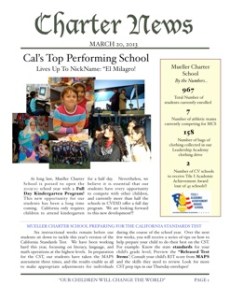
Because as of today we are 5 instructional weeks from the California Standards Test (the CST’s!)  and our teachers are studying their formative data and making some very strategic adjustments in how they work with their students on the final push.  5 weeks is the blink of an eye and they know it.   We are still a long ways away from where we need to be.  In fact, our MAPS data tells us that 22% of our English language learners are now operating at a proficient level in language arts and 23% in math.  We need at least 50% proficiency to reach the state’s Annual Yearly Progress (AYP) goal.  

This is crunch time.  Our teachers are as serious and as focussed as I have ever seen them.  There is no panic.  There is no quit.  There are no false illusions about where we are.  So it will be interesting to see how our students perform on California’s standardized tests in May.  

field-goal1This is also the time period in which we cease to philosophize about the wisdom of standardized tests and what the pre-occupation with language arts and math might be doing to our students’ broader abilities to think and innovate and solve problems and reason.  This is not the time to engage in the political debate.   An NFL coach may not like the rules for sudden death overtime, but when you are out of downs on your opponents’ 20-yard line, you better just trot out your kicker for the game winning field goal and argue about the rules of the game later.

ny-timesjpeg2So we are playing to win.  And when we win, we expect that there will be some interesting headlines in the morning newspaper.  Something like:


“California Charter School Shocks Education World”

or

“Mueller Charter School Achieves Unprecedented One-Year Gains”

or

“State Department Questions Legitimacy of Dramatic Test Results


It is a healthy exercise  to visualize your organization’s success and there are many ways to do it.  But try visualizing the newspaper headline that captures the essence of your  mission and celebrates the moment at which all your collective dreams and ambitions come to full fruition.  What will the headlines say? 

“Charter School Caps Decade of Innovation by Tipping 901 on API”

hands-up

As a visualization exercise, this headline is dramatic.  But it is more than an exercise… it is our mission.  And it is attainable.  We have implemented a longer day, a daily English language development program in every classroom, our assessment tools have improved and so has our capacity to use technology.  And those are just the highlights. So now all that is left is five weeks of instruction, a 45-yard field goal (against the wind)  and the long vigil at the news stand.  Just what will your headlines say? Perhaps ours will read:

“California’s Top-Performing

School Lives up to Its Nickname:

El Milagro!”

headlinez

Leave a comment

Filed under California charter schools, El Milagro, public education, teaching, technology in schools

5 PILLARS TO SAVE A NATION

education_hero

“Every so often, throughout our history, a generation of Americans bears the responsibility of seeing this country through difficult times and protecting the dream of its founding for posterity. This is a responsibility that has fallen to our generation. Meeting it will require steering our nation’s economy through a crisis unlike any we have seen in our time.”

This past Tuesday  morning, President Obama presented his proposed education reforms to the Hispanic Chamber of Commerce in Washington DC.  If the Hispanic Chamber of Commerce is going to advocate at all for Latinos and their children in the United States, they should take great confidence away from that bright, bright morning at the Marriot Ballroom.  In the background of the President’s message  is an economy that has been ground down to the core by too many individuals who were entrusted to leave the machinery of commerce better than how they found it.  But once they got their hands on the wheel, the temptation to achieve personal gain, the lack of compassion, the lack of regulation, the lack of restraint, the lack of moral guidance, the lack of patriotism–  led the country and the rest of the world– right over the cliff toward economic collapse.

stock-mrktjpegThis happened on the last President’s watch, the one that talked about patriotism and Christian values and keeping America safe.  The one that imposed No Child Left Behind on America’ s schools and accelerated an era in which the illusion of accountability and achievement has merely driven schools to gun the motor, spin the tires in the mud, and lurch forward in the wrong direction in a cloud of spent energy and system-wide exhaustion. Just like the economy.  President Obama said:

“Despite resources that are unmatched anywhere in the world, we’ve let our grades slip, our schools crumble, our teacher quality fall short, and other nations outpace us. Let me give you a few statistics. In 8th grade math, we’ve fallen to 9th place. Singapore’s middle-schoolers outperform ours three to one. Just a third of our 13- and 14-year-olds can read as well as they should. And year after year, a stubborn gap persists between how well white students are doing compared to their African American and Latino classmates. The relative decline of American education is untenable for our economy, it’s unsustainable for our democracy, it’s unacceptable for our children — and we can’t afford to let it continue.” 

So President Obama  connected the dots on the moribund economy and our bankrupt schools and the illusion of academic progress for a nation leaving virtually all of our children behind.  The two systems are inextricably bound.  

While there may have been too few voices signaling our economic demise with any authority or passion, we have been signaling the alarm from within our schools for 8 years:  educating children, particularly those who are severely impacted by our nation’s recession, requires a lot more than threats and bullying over standardized test results. But just as opposition to the war in Iraq was regarded as unpatriotic, warning of the dangers of such a myopic view of teaching children was disregarded as “excuses by educators who are afraid of being held accountable.”

We merely linked the academic future of our children to the economy and to the federal government’s responsibility to help ameliorate  those punishing risk factors that inhibit children’s learning.  And we were right.  In fact, two important studies were released this week that neatly framed President Obama’s vision for public education.  The first was a joint study from the Education and Public Interest Center at the University of Colorado at Boulder and ASU’s Education Policy Research Unit.  That report described seven “out-of-school factors” that profoundly influence students’ academic success and lead to inequalities among children: prenatal care; health care; food insecurity; environmental pollutants; family stress; neighborhood characteristics; and lack of extended learning opportunities, such as preschool or summer programs.  The report’s conclusion is that schools cannot address these variables alone.

And we’ve been saying that too.

20090323_107The second study came from the National Center on Family Homelessness who now estimate that one in every 50 American children is homeless. In summarizing the report  Time Magazine’s stated, “The consequences of homelessness are profound. Homeless children are twice as likely as other children to be retained, or held back, one academic year, or to be suspended or, ultimately, to drop out of school altogether. School districts across the country report a growing share of students who are highly mobile — who move multiple times within a school year. With each move, experts say, such students are at risk of falling some six months behind, or more, in their studies.” And as a result of our economic downturn, the trend of homeless children is growing.

Under the leadership of Secretary of Education Arne Duncan and President Barack Obama, we have an opportunity to reverse the downward spiraling course of public education as we simultaneously address childhood risk factors associated with our volatile economy.  And in fact, Mueller Charter School has been on that path for years– not because of any inspiration from NCLB, but rather, in spite of it!  From the energy and innovation and subversive entrepreneurialism that comes from being an independent charter we have created a school environment that models– at least in part– the President’s Five Pillars of Education Reform as he presented them on Tuesday: 

First Pillar:  Investing in early childhood initiatives like Head Start;  
 
Second Pillar: Encouraging better standards and assessments by focusing on testing itineraries that better fit our kids and the world they live in;         
“We will end what has become a race to the bottom in our schools and instead spur a race to the top by encouraging better standards and assessments.  That’s why I’m calling on states that are setting their standards far below where they ought to be to stop low-balling expectations for our kids. The solution to low test scores is not lowering standards — it’s tougher, clearer standards.  And I’m calling on our nation’s governors and state education chiefs to develop standards and assessments that don’t simply measure whether students can fill in a bubble on a test, but whether they possess 21st century skills like problem-solving and critical thinking and entrepreneurship and creativity.” 
Third Pillar:  Recruiting, preparing, and rewarding outstanding teachers; treating them like professionals and holding them accountable;
 
Fourth Pillar: Promoting innovation and excellence in America’s schools… supporting charter schools… reforming the school calendar and the structure of the school day;

“Now, even as we foster innovation in where our children are learning, let’s also foster innovation in when our children are learning. We can no longer afford an academic calendar designed for when America was a nation of farmers who needed their children at home plowing the land at the end of each day.  That’s why I’m calling for us not only to expand effective after-school programs, but to rethink the school day to incorporate more time -– whether during the summer or through expanded-day programs for children who need it. “

Fifth Pillar Providing every American with a quality higher education–whether it’s college or technical training.


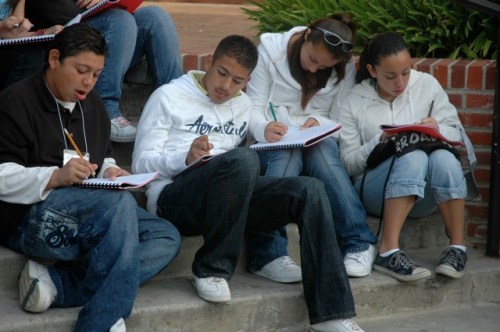
The ground shifted beneath our feet this week, as the President’s message signaled a change in course that favored children.  At nearly the exact same moment, 62 seventh graders from El Milagro were climbing the steps to a university that they had never laid their eyes on before. Our students visited San Diego State University, University of San Diego, University of California at San Diego, Cal State San Marcos and the Arts Institute.  In two weeks, our 8th graders will spend three days in Los Angeles visiting USC, UCLA, Cal State Long Beach and UC Irvine. They will see themselves in the faces of students on those campuses and their life course will be fundamentally altered: from their choice of friends to the goals they set and the courses they take in high school. They will likely be the first in their families to attend college. Their pathway will be made more clear as President Obama’s vision of education comes to fruition, and the unforgiving decline of America’s economy is halted.  

“We have a legacy of excellence, and an unwavering belief that our children should climb higher than we did,” the President said. 

In the meantime, we rise to the greatest challenge of our generation, to right the course of our economy and our public schools, and literally save our nation.
steps

1 Comment

Filed under California charter schools, charter schools, El Milagro, President Obama, public education

TWITTER AN AUDIENCE WITH THE GREAT GRAY WHALES


blackberryTwitter the whales.  That’s what you do when they are left out of the curriculum. At least that is what connected parents are doing.

A recent Washington Post article described how tech-savvy parents across the country are forcing school boards and superintendents and principals to knuckle under to their avalanche of Twitters, texts, e-mails and blogs demanding their local flavor of change.  I read about it on Dangerously Irrelevant (one of my sources of professional reflection) and found the gleeful comments of fellow readers surprising.  As if school leaders don’t have enough of a mountain to climb now they have to brace for a Twitter campaign to deliver the community’s “no confidence” vote. The anonymous nature of these tools creates some real ethical challenges for school leaders pushing hard on organizational change. (How do most people respond to unsigned complaint letters?)  

The blog drew favorable comments from parents and university educators who seemed to regard this development as a final tipping point in finally straightening out those screwed up public schools.  I thought it was interesting for different reasons:  perhaps tech-savvy parents can now hold universities accountable too.

For better or worse our universities have long served as the R&D branch of public education. Published scholars in our post-secondary schools of education emerge as the industry experts. K-12 educators  worship at the altars of countless consultants and college professors and attribute the weight of the Gospel to their words.  And that would be ok if it wasn’t for the fact that when it actually comes to teaching and learning…  the very last place to go to find the expert practitioners of effective pedagogy would be a college classroom!

images1-2For example: this week I was asking Kira about her Marine Biology class. Although her college is 5 miles from the Pacific Ocean, they will not once visit the tidepools or watch the annual migration of the gray whales or stop by the Scripps Institute of Oceanography or even go to Sea World.  She has one class in a “lecture hall” where 150 students passively take notes from a “professor” inculcating his world view with the help of last year’s powerpoint.  Not very enlightened.  I wonder who I can Twitter about that.
Then Keenan has a class at San Diego State that requires students to go on-line for many of the lessons. It is very economical in that it saves everybody from having to show up for class… but adds to students’ stress (and expense) as they attempt to navigate the idiosyncrasies of another professor’s poorly designed website.  And what do they get when they finally break past the bonds of clumsy technology:  a talking-head video of– you guessed it– last year’s powerpoint.  Or text they could have just Googled.

sdsujpegAren’t these university professors–these giants of the trade–  reading their colleague’s stuff.  Marzano? Bloom?  Gardner? Freire? Cooperative learning? Gradual Release? Are you kidding me? Why aren’t they teaching each other?

An unfair generalization?  No doubt.  Of course there are extraordinary teachers in the university system and some schools have a lot more of them than others.  But if we are going to paint public education with such a broad brush at the K-12 level, it applies all the more in our universities in whom we trust the preparation of future teachers and leaders.  

The tail is wagging the dog. Americans intent on promoting school reform would do well to shift their gaze from the university system to the real experts in teaching and learning:  those high performing elementary school educators who engender extraordinary academic results in spite of challenging environmental factors, in spite of an upside down school system, in spite of the perception that public schools need to be “reformed”, and in spite of the continued reverence for bad teaching that is too often modeled by university-based “experts” that they turn to for answers.  The real experts, it seems, reside in places like El Milagro.

ricky1

Maybe engaging all these parents and community-members who are technologically connected and bent on improving instruction in their children’s schools is not a bad idea. If it works at the local high school, surely it will work at the university too.

So let’s Twitter the school’s president and get Kira an audience with the great gray whales.

whale-tail

1 Comment

Filed under California charter schools, El Milagro, public education, Uncategorized

WORDS MADE CHANGE

Like this tag cloud designed by Wordle, everyone heard something different in President Obama’s Inaugural Address:

image0011

I don’t know what images or themes resonated for you, but Nelson Smith, the Executive Director of the National Alliance of Charter Schools reviewed the historical Inaugural Week in his Charter School Blog, and he heard this:

I found a strong echo of our [charter school] model in this passage of the President’s inaugural address:

 “The question we ask today is not whether our government is too big or too small, but whether it works — whether it helps families find jobs at a decent wage, care they can afford, a retirement that is dignified. Where the answer is yes, we intend to move forward. Where the answer is no, programs will end.”

What this means for charter schools can be found on the new White House web site under Education Agenda. President Obama promises to “double funding for the Federal Charter School Program to support the creation of more successful charter schools,” but warns there will be “a clear process for closing down chronically underperforming charter schools.”

Fair enough.  As on most things, I agree with President Obama (and Nelson Smith, too). But how will the President define “successful charter schools?” and what are the criteria for an “underperforming school?”  

Presently “underperforming schools” become “underperforming schools” when their test scores in math and reading fall short of the prescribed benchmarks called Annual Yearly Progress or AYP. And since nobody wants to bear the mantle of an “underperforming school”, you can be sure we all teach the heck out of math and reading.  President Obama recognizes that schools have narrowed the curriculum in response to these pressures at the expense of science and technology and social studies and the arts.  And recess. He calls it teaching to the test.  I call it teaching to what is tested. Others may call it teach what you better teach if you don’t want lose your charter or be called an underperforming school.will-i-am

Nevertheless, as Will.i.am says “It’s a New Day” and thank God for that.  We have a mandate for change.  And since I don’t mind using test results to determine how effectively schools are serving children and their families, I don’t care whether president Obama changes the whole assessment game or not.  

What I do care to C H A N G E is how we recognize and define successful schools– charter or otherwise. Math and reading results are one indicator, but can we get some love for the other extraordinary things that happen for children at El Milagro?

Like when we …carlos

• introduce our children to the latest technologies…

• or teach them to think…

• or refer them to the eye doctor for properly fitting glasses…

• or teach them proper dental hygiene so their teeth aren’t rotting in their heads…

• or  teach them to sing and draw and recite their poems on a stage…

• or  teach them that their forefathers won congressional medals of honor in foreign wars too…

• or help them preserve and perfect their native language…

• or connect a family to health insurance…

• or help Rafael properly grieve for his relatives who were recent murder victims in Tijuana’s horrific drug wars…

• or help Laura stay grounded even as she  is about to lose her mom to stomach cancer (which is a big deal because her dad passed away two years ago)…

And so forth.  Supporting kids in crisis– isn’t that high performance too?

Just last summer, Nelson Smith and The National Alliance of Charter Schools published a tool they call “Quality Indicators“.  It’s one way to expand the definition of what a successful school is.  So at El Milagro we decided to integrate the general concept into our charter as we get ready to take it to the local governing board for re-authorization in March.   We will be able to describe the goals of our charter in broader terms than just academic achievement– but also longitudinal growth, progress of English Language learners and the sense of engagement for students, teachers and  parents.

                                                             *                *                  *

So when Wordle created their cool tag cloud from some of the major themes and words that were used by President Obama in his Inaugural Address, they were unintentionally shining a bright light on his priorities.  The bigger the word the more often he used it.

 I like that C H A R T E R and  C H I L D R E N are so predominantly positioned on the top of the box, and in the center– and that they are surrounded on all sides by C A R E  and  C O O P E R A T I O N and W O R K and  H O P E.

monument

1 Comment

Filed under California charter schools, charter schools, El Milagro, President Obama, public education

BABEL’S TOWER

globeOn January 2, 2009, I challenged readers to consider what happens to our students when you test them in a language that is not their native language, and then pass judgment on them and on their teachers based on the predictable results!  I invited readers to take a quiz and to not be discouraged by the fact that the quiz is in a foreign language.  

This issue is huge.  It has less to do with test scores and more to do with how we are preparing our children to compete globally.  Or not.  (Check out who is about to become the largest English speaking country on the planet.)  Of course our students need to speak English, but why aren’t they speaking other languages, too?  

Anyway, if you took the quiz you experienced what many of our students experience.  They may know the material and have the skills in math or reading or writing– but their academic proficiency (and intellect, motivation, potential, etc.) will be determined primarily by their ability to master a second language and the confidence they have in themselves as second language learners. 

Here were the 3 questions:

Question Number 1:

quiz


Если ваша профессиональная репутация, ваша школа рейтинга, и будущее ваших учеников были все зависит от детей, каким образом осуществляется на стандартизированных испытаний, которые приведены в иностранном языке, вы должны:

А. выступаем за то, чтобы дети предоставили оценки на их родном языке ,

B. энтузиазмом участвовать в вашей государства осуществлять в учебных злоупотреблений;

C. вид, что исход отметив делать с языком, или

D. привести ненасильственного протеста

Question Number 2:

كاليفورنيا يطالب بأن تتخذ جميع الأطفال أنصبتها المقررة باللغة الانكليزية للأسباب التالية :

أ. انها حقا جيدة للأطفال

ب. لأنها أكثر موثوقية وسيلة لتحديد ما تعلمه الأطفال

C. لأنها ستوفر معلومات قيمة والمعلمين حول ما يعرف الطلاب

د. وسوف نتأكد من الطلاب لا يملكون غير عادلة رئيس جامعة كاليفورنيا تبدأ اللغة الأجنبية

Question Number 3

Λαμβάνοντας αυτό το παιχνίδι δεν είναι ένα έγκυρο κριτήριο της τη νοημοσύνη μου, διότι:

Α. Δεν μιλούν καμία από αυτές τις γλώσσες

Β. Είναι απλά μια προσομοίωση

C. Είμαι πραγματικά πολύ έξυπνη και μόλις πήρε suckered σε αυτό το κουίζ

D. Αν όλοι μιλούσαν αγγλικά δεν θα είναι απαραίτητα αυτό το κουίζ


Did you pass?  You don’t know?  Well here is the translation:

Question 1, which was written in Russian, asks:

If your professional reputation, your school’s ranking, and the future of your students were all dependent on how children performed on a standardized test which is given in a foreign language, you should:

A. Advocate that children be provided the assessment in their native language

B. Enthusiastically participate even if you consider it educational malpractice

C. Pretend that the outcomes have nothing to do with language; or

D. Lead a non-violent protest to end the demoralizing practice

Question 2, written in Arabic (thanks to Google Translate), asks:

California demands that children take all of their assessments in English because:

A. It is really good for kids

B. Because it is a more reliable way to determine what children have learned

C. Because it is consistent with the “English Only” agenda

D. It will make sure no student has an unfair head start on the UC foreign language requirement

Question 3, which I am sure was all Greek to you, asks:

Taking this quiz is not a valid test of my intelligence because:

A.  I don’t speak any of these languages

B.  It is just a simulation

C.  I am really very smart and just got suckered into this quiz

D.  If everybody spoke English this quiz wouldn’t be necessary

Your score on this quiz doesn’t matter very much.  Your answers, however, are critical!!!

dsc016711

1 Comment

Filed under California charter schools, charter schools, El Milagro