Category Archives: public education

THE TURN-AROUND PLACE

Allen Odden is a professor of educational leadership and policy analysis at the  University of Wisconsin-Madison who claims to know how to turn around low achieving schools.  In fact he wrote a book about the topic called “Ten Strategies for Doubling Student Performance”.  He doesn’t work in schools, he studies those of us who do.  So his premise is that school turnarounds are not a new phenomenon and that “we”  know how to fix them, and “we know how to literally double student performance in low income schools, and in the process take huge chunks out of the achievement gaps that separate students along racial and socioeconomic lines.”

In a recent article in Education Week entitled We Know How to Turn Schools Around, Odden identifies 10 core elements he picked up from studying schools just like El Milagro.  Here is Odden’s checklist:

ONE: Create a sense of urgency.

TWO:  Set ambitious goals: (e.g.; to double student performance on state tests, to double the percentage of students scoring at advanced levels, to make sure that no student performs below the basic level at the end of 3rd grade, and that all students leave that grade reading on level.)

THREE:  Throw out the old curriculum and adopt new textbooks, create new curriculum programs, and start to build, over time, a common understanding of effective instruction.

FOUR. Move beyond a concentration on state tests and use a battery of assessments, including formative and diagnostic assessments, common end-of-curriculum-unit assessments, and benchmark assessments.  All of these enable teachers to make midcourse corrections and to get students into interventions earlier.

FIVE:  Create and implement an intensive and ongoing professional-development program. (The best schools form collaborative teacher teams— aka, professional learning communities—that meet often, make use of student data, and work with school-based coaches to improve curriculum and instruction.)

SIX:  Provide extended learning time and extra help for all students to attain proficiency. (e.g., Some combination of one-on-one or small-group tutoring for struggling students, together with extended-day and summer programs that emphasize providing academic help.)

SEVEN: Use time effectively. (Core instructional time for reading, math, and increasingly science is protected from intrusions; each minute is devoted to teaching the class. Literacy time often is extended to 90 to 120 minutes a day.)

EIGHT:  Teachers lead grade- and subject-based professional learning communities. Most of the instructional coaches are the school’s best teachers, and they orchestrate the overall professional-development system. And principals provide real instructional leadership.

NINE: Staff members read the most recent research, reach out to experts in the field, look for and use best practices, and take responsibility for assessing the impact on student learning of what they do, improving instructional practices when student results are not what’s desired.

TEN:  Recruit the talent needed to accomplish lofty goals and implement the collaborative and powerful educational strategies discussed here.

Ok.  So that is his list.  It just so happens that at El Milagro we have been down the path on all 10 core elements.  They are in place. Maybe that is why we have never missed an AYP goal, never missed a year of positive gains on the API, and recently been named a Title I Academic Award Winning School in the state of California.  Or maybe our success has come from going even deeper when initiating school reforms.

There are three problems with the good professor’s premise:

First, it assumes that a “turn around school”  is one that is getting better test scores.  But  perhaps the bigger challenge in school leadership is protecting kids from the craziness of schools obsessed with higher test scores– while still getting higher test scores! It is harder to get results when you refuse to become a test prep academy or when your school still values the meaningful extracurricular activities that don’t always directly tie in to testing (like athletics, theater, the arts, and music).

Secondly,  this article (and the publication of his book!) assumes a college professor has some authority on an issue he has “studied”… as opposed to a having actively engaged in the work of really turning a school around!  It is much like hiring a sports writer to coach an NFL team to the Superbowl or a film critic to create an academy award winning movie.

Finally, in concentrating on these broader, more obvious initiatives that we already stumbled across years ago… Odden’s list misses (at least )10 core elements that run even deeper into the DNA of a successful school.  For example, we have found that to turn a school around and sustain long term, continuous improvement, you must:

• Strike a BALANCE between raising students and raising test scores

• ENGAGE CHILDREN  in their own learning and growth; help them to be experts in analyzing their own test data and set goals accordingly

• Lead parents in a community transition from parent involvement to PARENT ENGAGEMENTwhere parents’ energy is first and foremost directed toward helping their child be a successful learner

• Integrate successful TECHNOLOGY solutions that bridge the digital divide and simultaneously accelerate learning

• Create systems that support STUDENT WELLNESS (academic, social, emotional, mental, medical, dental), especially for students who are otherwise at high risk

• Promote healthy NUTRITIONAL HABITS  and a climate that promotes daily exercise

• Maintain a BEHAVIOR POLICY  that is clear, democratic, humane, and prudently applied (as opposed to “zero tolerance”)

• Promote COMMUNITY SERVICE and each students’ capacity for contributing to others

• Create a sense of individual EFFICACY  among staff and students

• Foster RESILIENCY in individuals and in the school organization as a whole.

Those are my ten.  For now. There will be more innovations for professors to study in how we turn our schools around.

2 Comments

Filed under charter schools, El Milagro, innovation and change, public education, resiliency, school reform, standardized testing, teaching

LIVING STRONG

It seems like we are swimming in data.

The sun is shining and the lifeguard tower is buzzing with activity.  (I wonder sometimes if they are really keeping their eyes on the water.) I wonder who is up there at all. No matter, we have our fins… and we are swimming in a sea of data.

We swim with the tide and sometimes we push against it.  But one thing for certain when you are swimming in data:  there is no shortage of information.  And no shortage of assessments that produce the data.  It’s like an underwater upwell pouring volumes of new trends into the channel.  Creating more waves.  Faster currents.  A nuanced flow.  And of course, the occasional rip tide that threatens to pull you out beyond the comfortable landforms that tether us all to the beach; like this past week, when a rogue wave washed across and knocked us off our feet… just as we were looking comfortably in another direction.

New data.

California released the results of the 2009 Physical Fitness Tests that were administered  last Spring to all of our 5th  and 7th graders. In a nutshell… our kids tanked!  We were in the bottom 10 in a district of 44 schools.  Bottom 10 because only 14% of our 5th graders met the physical fitness benchmarks for all 6 (out of 6) exercises.  7th grade was not much stronger: 17% met all 6 benchmarks.

They were not asked to swim across the English Channel or benchpress their teacher’s Prius.  They were not required to compete in the Rock and Roll Marathon. They simply had to meet the benchmarks on a prescribed set of exercises:

Sit-ups

Push-ups

Sit and reach

Torso Extension

Interval Run (Aerobic)

Body Mass Index

14% were able to do it.  The very best school in the district managed to have 50% of their students meet the benchmarks.  Statewide… it was only 34%.

So during our staff meeting last Friday we looked at the data as if it were accurate and reflective of our students’ state of fitness.  We identified the tidal trends; made no excuses.  We asked what is up.

“What is up?  How is it that we are a charter school, with all the resources we need to serve our kids–  a track,  a fitness course, a PE program, competitive teams, and a director with a degree in Physical Education… and this is the result?  What is up?!”

And we brainstormed the root causes just like we dig deep into the data on reading and writing and algebra and math and science and social studies.  We looked at the trends.  We looked at our 5th graders’ relative strength (aerobic) and weakness (flexibility!) and how it seemed to shift by 7th grade where their strength was sit-ups and weakness was the torso extension (weakness in the lower back  is a bad harbinger for high school athletics!)

We concluded that these results stemmed from at least three conditions:

• First, we did not do a very good job of preparing our students (or teachers… or parents) for the 2009 Physical Fitness Test.  It twas an afterthought conducted hastily in the Spring while everyone had their eye on the California Standards Test.

• Second, our students are not getting enough EXERCISE.

Many are sedentary couch potatoes who would rather play video games or watch television than go outside and exercise.  Sometimes overprotective parents encourage them to stay indoors.  And in some neighborhoods you can hardly blame them. Our school is bordered by trolly tracks a freeway and surface streets that race and crowd like freeways.  There are shady motels, apartment complexes with high turnover and strange faces, sex offenders, street gangs, graffiti artists, and a lot of unsupervised kids of all ages.  And there are limited places to exercise.

• Third, our students, in general, do not have healthy DIETS. They eat bags of red hot cheetos and takis the size of pillows.  They drink Red Bull and sugary juice mixes and 64 ounce caffeinated sodas– they consume endless fast food and junk food offered in over-sized portions.

And in a community bearing now the full brunt of the nation’s sagging economy–  the unemployment, the lack of health care, the work-three-jobs, the all nighters and grave yard shifts, the eat-to-survive and find-whatever-comfort-food-you-can— our children pay.

According to the National Association of Children’s Hospitals and Related Institutions (NACHRI):

“This is the first generation of children that will be sicker, and die younger, than their parents.”

At El Milagro, this got our attention. So we found some more data:

• 16 percent of children (over 9 million) 6-19 years old are overweight or obese — a number that has tripled since 1980.

• In addition to the 16 percent of children and teens ages 6 to 19 who were overweight in 1999-2002, another 15 percent were considered at risk of becoming overweight.

• Overweight adolescents have a 70 percent chance of becoming overweight or obese adults.

• Obesity-associated annual hospital costs for children and youth more than tripled over two decades, rising from $35 million in 1979-1981 to $127 million in 1997-1999.

• Nearly one-third of U.S. Children aged 4 to 19 eat fast food every day, resulting in approximately six extra pounds per year, per child. Fast food consumption has increased fivefold among children since 1970.

• Approximately 60 percent of obese children aged 5 to 10 years had at least one cardiovascular disease risk factor, such as elevated total cholesterol, triglycerides, insulin or blood pressure, and 25 percent had two or more risk factors.

• For children born in the United States in 2000, the lifetime risk of being diagnosed with Type 2 diabetes at some point in their lives is estimated to be about 30 percent for boys and 40 percent for girls.

• According to the Centers for Disease Control and Prevention, Mexican-American children ages 6-11 were more likely to be overweight (22 percent) than non-Hispanic black children (20 percent) and non-Hispanic white children (14 percent).

• There are more than 8 million uninsured children in the United States.

Sometimes there are treasures that wash ashore from that sea of data.  There is an idea or a thought or a new direction or inspiration or a movement or even the seeds of a revolution.  Like this:

We realized our kids weren’t physically fit and that their lack of fitness was a result of poor NUTRITION and a lack of EXERCISE. And that, like many of the circumstances of their lives, much of it is environmental.  It is a socio-economic phenomenon.   It is for many parents a lack of knowledge, or time, or resources, or energy to encourage a healthier pattern.

And we haven’t helped. So starting in January we are no longer allowing bags of chips and sugary drinks and junk food snacks on our campus.  We are taking the 160-calorie sport drinks out of the vending machines and replacing them with bottled water.  We are prohibiting classroom parties that feature stacks of Von’s cupcakes and dixie cups filled with Mountain Dew.

Healthy snacks only. 100% frozen juice bars instead of popsicle rewards.

We will teach our students how to read nutrition labels.  We will give them the skills to defend themselves against the conspiracy of junk food marketers that intentionally manipulate ingredients– more fat, more sugar, more salt, bigger portions– to lure them in.

And we will inspire our students to exercise.  We will challenge them to be active at least :60 minutes a day.  Academic progress is in large part a function of wellness.  Kids who are fit and healthy and well nourished perform better than sedentary children whose eating habits are haphazard.

That’s what we learned this week from the sea of data.  It was a seminal moment.  A gift to our students that will no doubt take them some time to appreciate. To live healthy.

To Live Strong!

3 Comments

Filed under California charter schools, childhood obesity, children at risk, El Milagro, physical fitness, public education

WHAT IF HOPE WAS A NATIONAL PROMISE?

So we are down in Georgia attending a community charity event for Intuit. I didn’t bring my laptop so I am writing this post from my phone. No pics today… just this thought: what if the “free and public education” system extended into college? Like here in Georgia.

Clay told me that every graduating senior in the state is eligible for the Hope Scholarship; if they maintain a minimum GPA, and get accepted into a university in Georgia, all tuition is covered!

An awesome program. I wonder how many states offer their kids the same promise? How many kids take advantage of it? How far has it gone to bridge the sociology-economic divide? How do high schools tap into the grant and get their students on college campuses EARLY?

I wonder… what if the $30 billion a week spent on war…  or the $ trillion-plus investment into the pentagon… or the one million dollar a year per soldier… was invested here… for our kids… in our universities… to make college affordable; To make colleges and universities more accountable for the quality of their teaching? Like K-12 schools. No College Kid Left Behind.

2 Comments

Filed under college, El Milagro, innovation and change, post-secondary education, public education, teaching

CHILDREN GROOMED TO SOW OUR FATHER’S PEACE

greatestMy father was a  member  of the “greatest generation”.  Salt of the earth.  Bright.  Self-educated.  A patriot.  As an officer of the United States Navy he saw action in both World War II and Korea.  He was on the blockade in the Mediterranean when Krushchev’s missile-bearing fleet tested JFK’s courage.  All those brave Americans from Massachusettes and from Camden… and not one of them blinked.  And so Russia was turned back and it was the beginning of the end of the USSR.


My father’s service to his nation was not provided for political purposes or jingoistic calculation.  He served with honor.  I would never want anything that I say or do denigrate his record, or his service.  Or his memory.

However, I was stunned by an article that appeared in several publications this week, including Education Week.

It seems as though the role of our schools is now to prepare our children for the military.

A new report from an organization called “Mission Readiness: Military Leaders for Kids states that the United States “should invest in early education to help bolster the number of young people eventually eligible to serve in the military and protect national-security interests.”

According to their website:

On Thursday, Nov. 5, the generals and admirals of Mission: Readiness, along with US Secretary of Education, Arne Duncan, released a new report that details the fact that 75% of young Americans are unable to serve their country because they have either failed to graduate high school, engaged in criminal activity, or are physically or mentally unfit.

How do you read that?

Is fitness for the military the new bar by which our children will be measured?

I thought we were preparing them for the best universities on the planet.  I thought we were preparing them to be literate, thinking, caring members of our communities.  I thought we were preparing them to excel with 21st Century skills.  I thought we were preparing them to change the world!

Clearly these goals are compatible with service in the military.  And the veteran officers have rightly pointed to juvenile crime, high school drop-outs, and childhood obesity as conditions that compromise America’s future on every level.  They are advocating that Congress pass a bill to provide more funding for early education- an urgent  need in so many communities.

“Human capital is the success this country is going to need for the 21st century,” said retired Army Maj. Gen. James W. Comstock.

Human capital?  Is that who we are teaching?

I’m sorry.  I work among children and teachers every day.  I watch them struggle and learn and compete and sometimes even cry together.  Those whom an Army general would refer to as “human capital” have names and faces.

at inaug

In good conscience, how do I prepare those children for military service;  for interminable war that even our President cannot comprehend; for the ultimate sacrifice that soldiers and sailors are asked to make in shadowy lands… against faceless enemies.

The truth is, the armed forces will continue to draw the best and  the brightest as they always have.  They will attract the likes of Patrick Tillman. And my father.  And all his brothers.  And all my mother’s brothers too.  And my own brothers.  And all those souls for whom we will pause and remember on this coming Veteran’s Day. They will attract them when the cause is right and when they are led by their own sense of duty and patriotism.

Perhaps modern military warfare– 21st century warfare– will one day reach a point where killing other people and depleting the “human capital” of our enemies, is no longer the objective.  When our military is dependent solely on brain power– on technologically sophisticated kids who can solve problems and think critically and creatively to insure our freedom through statesmanship and diplomacy– then turning to our public schools to prepare students  for military service will be an objective worthy of our father’s sacrifice.

image79_jpg

3 Comments

Filed under El Milagro, President Obama, public education

CHEATING OUR KIDS

testingThis past week the National Center for Education Statistics released a report that may have been a shocker for people outside of the education industry:  when it comes to student achievement, many of our states are cheating!  Or at the very least, they are cheating their kids.

According to an article in Education Week, their results suggest that between 2005 and 2007, various states made their standards less rigorous in one or more grade levels or subjects in at least 26 instances.

“I think as 2014 looms, … clearly what a lot of states are doing is changing the bar so that a lot more students will become proficient,” said Mark S. Schneider, who served as the NCES commissioner from 2005 to November 2008.

Surprised?

What do you expect from high stakes tests that threaten people’s jobs and their professional reputations? When you have put so much stock in leveraging improvement trends on standards-based tests… you invite otherwise well-meaning people to cheat.  So politicians who run on a promise to “improve public schools” and “raise the test scores’ and “close the achievement gap” will do what politicians do to stay in office.  And by lowering the bar in places like New York, you can create the illusion that more students are getting to grade level on your watch.  Even if they aren’t.

The states are free to establish their own standards and select their own tests to determine who has mastered those standards.  And they are free to define “Proficient” for their own students.  The lower the bar is set, the more students will test at “Proficient”.  And when you compare the students in states where the bar has been lowered to the students in California– if you don’t know those states are gaming the system– you will conclude that California’s public schools are inferior.

This is happening because there are no national standards or definitions or assessments required by NCLB.  It is a loophole for any states that choose to use it.  And how do we know that so many states are sand-bagging their kids?  All you have to do is look at the National Assessment of Educational Progress, an optional national test that assesses kids in 4th and 8th grade.

In 4th grade reading, for example, the federal study found that 31 states set proficiency scores that were lower than the cutoff for “basic” performance on NAEP. At the 8th grade level, 15 states set standards judged to be lower than the basic level on the national assessment for that grade.

The Northwest Evaluation Association has been reporting on this phenomenon for several years.  They too maintain that it is just easier to demonstrate proficiency in some states than it is in others– like California.

So the pressure gets turned up in California… from the top down.  And what happens?  Schools stretch to get their kids to those higher, more stringent levels of achievement– by any means necessary. And yes… they cheat.

One of California’ most celebrated charter schools is unapologetic in their methods.  They, in effect, have replaced their curriculum with the California Standards Test. They teach the test.  Every day.  And they hand-pick their students and eliminate those who don’t keep up with the daily rigors of “drill and kill”– the doctrine of test preparation.  The result? They are one of the highest performing schools in the entire state with an Academic Performance Index of 967!  The governor sings their praises because they demonstrate that getting all of your students to grade level can be done.

govBut the California Department of Education (over which the Governor presides)  forbids the practice of test preparation.  Regarding advance preparation for state tests, the California Code of Regulations, Title 5, Section 854 (a) states:

Except for materials specifically included within the designated achievement test, no program or materials shall be used by any school district or employee of a school district that are specifically formulated or intended to prepare pupils for the designated achievement test. No administration or use of an alternate or parallel form of the designated test for any stated purpose shall be permitted for any pupils in grades 2 through 11, inclusive.

So they are cheating!  At least in spirit. But even worse, they have stripped the curriculum and the school of the real things that matter: the 21st century skills, the arts, technology.

And not to pick on one school, this practice is rampant in the state.  Teachers, by necessity, must provide daily test prep in one form or another to meet the accelerating expectations on the federal law, and their Governor, and their school boards.  And they must focus on the narrow scope of standards that are tested– especially language arts and math.

So they are all cheating their kids.  And one day soon, they will realize that for their collective zeal to game (or survive) a very flawed testing scheme… our students will pay.

our kids

3 Comments

Filed under charter schools, public education, school reform, standardized testing

CALIFORNIA, THINKING, AND THE WILD WILD WEST

gretzkyCorporate CEO’s and forward thinkers like to use the Wayne Gretzky analogy.  Gretzky scored 940 some goals in his 20 career in the NHL.  But he never skated to the puck in order to take his magic shots.  If he skated to a hockey puck angling off the boards at 100 mph, it would be gone by the time he got there.  So Gretzky was as good as any hockey player that ever played the game… at skating to where the puck was going to be.

That’s forward thinking. Broad vision.

timeSo in light of the Wayne Gretzky analogy, this week’s lead story in TIME Magazine is reassuring.  California, it seems, is not falling off into the Pacific Ocean after all.
Oh sure, there are earthquakes and wildfires and crazy environmentalists chaining themselves to the railroad tracks in defense of the ecosystem.  There are gangs and home foreclosures, long unemployment lines and long lines at the frenzy-producing freeway merge.  There may be shuttered businesses and legions of workers whose origins are driving Lou Dobbs nuts.

But in general, there is enormous up-side in the Golden State and its powerhouses of innovation that are skating to where the puck is going to be.

Michael Grunwald writes:

It’s still a dream state. In fact, the pioneering megastate that gave us microchips, freeways, blue jeans, tax revolts, extreme sports, energy efficiency, health clubs, Google searches, Craigslist, iPhones and the Hollywood vision of success is still the cutting edge of the American future — economically, environmentally, demographically, culturally and maybe politically. It’s the greenest and most diverse state, the most globalized in general and most Asia-oriented in particular at a time when the world is heading in all those directions. It’s also an unparalleled engine of innovation, the mecca of high tech, biotech and now clean tech. In 2008, California’s wipeout economy attracted more venture capital than the rest of the nation combined. Somehow its supposedly hostile business climate has nurtured Google, Apple, Hewlett-Packard, Facebook, Twitter, Disney, Cisco, Intel, eBay, YouTube, MySpace, the Gap and countless other companies that drive the way we live.

Innovation implies the flourishing of  ideas that haven’t even been launched yet, defying the status quo.  It rewards early adopters and those who integrate technology in the most unlikely of ways.  Like Kogi, writes Grunwald, the Korean taco truck that announces its location via Twitter. “The beauty of California is the idea that you can reinvent yourself and do something totally creative,” says Kogi’s Roy Choi, a former chef at the Beverly Hilton. “It’s still the Wild West that way.”

But as forward leaning as the TIME Magazine piece on California is, it missed a chance to recognize that our schools have also evolved at light speed from the Fast Times at Ridgemont High.

When Grunwald celebrates the culture of innovation that produces breakthroughs in chip-industry, solar, LED lighting, green materials, the digitized grid, biotech, algae-to-fuel experiments, synthetic genomics, carbon-capturing-cement, sugar to diesel, semiconductors, and energy-efficient windows… he could have been a game changer himself… the first to recognize the relationship between innovative public schools and the fast companies they serve.  Instead, he states that California public schools “pose a real obstacle to the dream of upward mobility” and that they have been “deteriorating for years.”

Really? Deteriorating?  You are clearly thinking of Spicoli’s public schools.  Not mine!

laptops

California passed its charter law  in 1992, one of the first states in the country to do so.  There are now 750 charter schools serving 276,000 kids. 90 new charters opened in 2007 alone.  There are charters of every kind from High Tech High to El Milagro.  They flourish in a state that is unique for its size and diversity. Where 64% of its student population are children of color… third, only behind Washington DC and Hawaii.  A state where nearly half the students qualify for free or reduced lunch and where 1 out of 4 are English language learners.  A state that invests only $9,152 per student  (while New York invests  $15, 981 per student).  And where we don’t make excuses.

And while other states are relaxing their standards or lowering the cut point that determines grade level proficiency, California remains one of the most difficult states in America to test out at grade level.  The expectations here are sky high.

There are still many underperforming schools… but I don’t know where they are.  And if I did, I wouldn’t defend them.

I do know however, that schools like El Milagro continue to compete in an environment that is destined to change.  We will not be able to sustain schools as test prep academies to the exclusion of the real skills and talents that will feed into our innovative industries.  Solving energy and the riddles of biomedicine can not come from multiple choice tests.  The future demands creativity.  Critical Thinking. Resilience.

So you can be sure there are schools like mine, skating to where we envision the puck will be.  That’s California too.  Revolutionary thinking and the wild, wild west.

wcalifornia_1102

Leave a comment

Filed under California budget, California charter schools, charter schools, El Milagro, innovation and change, lou dobbs, public education, resiliency, school reform, technology in schools

CROSSING THE API BRIDGE WE HAVE COME TO

cautionjpegWarning!

This is NOT a post about how screwed up the whole high stakes testing and accountability movement is.  It is NOT  a scathing criticism of NCLB or the misguided goals of our public policy toward schools. It is not a rant about how access to health care for all students would do more to decrease the achievement gap than almost anything the schools themselves could do,or how inadequate standardized testing is a measure of real learning, or how the release of the NAEP test results this past week indicate that there has been very little overall improvement in reading in 4th grade over the past 20 years.  And in this post I will NOT lament that we have in effect become glorified testing and tutoring centers as monuments to Stanley Kaplan, or how when it is all said and done– even those schools that create extraordinarily high test results– may not be providing students what they really need to excel as 21st Century citizens.

Rather, this is post is about three students who I most likely would not have met and worked with this week if it were not for the demand from the state of California that we raise our Academic Performance Index– our API.

The API is a composite three-digit score that represents how our students, as a whole, performed on the California Standards Test last May.  Every school in California has one.  It is a measure of growth from one year to the next.  Schools that are standards-based, aligned, focused on children, and utilizing state of the art teaching strategies should be able significantly improve their API each year. All schools in California are expected to find a way to eventually score a minimum of 800.

As expected, schools in more affluent neighborhoods are in the high 800’s and 900’s while schools in lower socio-economic communities tend to score much lower.  THAT… is the achievement gap.

Our API at Mueller Charter School was 520 in 1999, and it is now 797.  That would be a pretty impressive gain in a lot of places, but here in Chula Vista, there are 5 schools within a few miles of us–  with the same demographics– who are now well into the 800’s, including one school that is at 865!

While we are an independent charter school and we are free to design our own program we are also highly competitive.  865?  That is where WE are supposed to be!  In fact, our charter is based on a promise that 90% of our students– regardless of their socio-economic circumstances– will be at grade level.  If 90% of our students were at grade level… our API would be at 900! And that is the bridge we need to cross now.

spyingSo we peeked over the fence at what those other schools were doing. We infiltrated their ranks.  We looked at the materials they were using and snuck in their classrooms and took pictures.  We even bought them lunch and straight-out asked them: “What the hell are you doing to get those results?”

What are you doing that WE aren’t doing?

The answer may surprise you.  It may disappoint you.  But they are not cheating! They are not just doing test prep activities all day long. They have not abandoned their students who are not likely to score Proficient.  They are not disenrolling low performing students or encouraging their parents to transfer to El Milagro.

They are, in fact,  aligned in every way to get higher test results.  Their teaching, their approach with their parents, their schedule, their instructional strategies, their mindset, their learning activities are all geared for higher test results.

Now that could be good or bad depending on what kids might be missing while they are being offered a school program that is aligned toward test results.  But it is hard to argue against schools where kids have developed the basic literacy skills necessary to score higher on the CST than they did the year before.

It is hard to argue against school improvement.

DSC01067So that brings us to three girls from Ms. Etter’s class that I worked with this past week.

One of our strategies this year is that we have extended the school day by :45 minutes for a targeted group of students– that is, any student not currently at grade level. Every teacher in grades 2 – 5, has identified a dozen or so students who need additional, guided instruction and so they work with them diligently.  Every day.  Then we created a team of tutors to assist them.  That team includes me and our Principal, our head counselors, our school psychologist, all of our Kindergarten and 1st grade teachers, and even Mr. Wizard our technology director.  Anyone that is not assigned a class and that has a teaching credential (or something similar) is on the support team! We are each assigned to one classroom where we will work with the two or three of the lowest performing students for the rest of the year.  And I have Ms. Etter’s 5th grade.

This week my three students and I worked together on a reading passage that comes from California’s “CST Released Test Questions. It was a passage about a music box, accompanied by six, multiple choice  test questions. Here is what I learned:

These three students are probably representative of many of our struggling students in California–

• They are English language learners who fell behind early in their school careers.

• They prefer to speak in Spanish because it is easier and because that is what they hear at home.

• They have had only modest gains in language acquisition.

• They were unfamiliar with basic English words, phrases and idioms that appeared in the passage: “attic”, “passed away”, “in the middle of nowhere”…

• In general, they don’t know stuff.  What we would assume to be general knowledge for a 5th grader, (aka: Prior Knowledge) they just don’t have… they don’t know much about music boxes or Haley’s Comet, or armadillos or any of the other general topics that appear in expository reading passages on the CST.

• They don’t know that they don’t know stuff.

• They demonstrate limited initiative to learn stuff.

• They don’t have strategies to attack CST questions: particularly ones that are difficult for them.

• They don’t have the patience or the persistence to work through test questions, to eliminate the obviously wrong answers, to search for context, or any other tricks good test takers use.

calculationsAnd even though Cassandra is Far Below Basic and not likely to improve significantly enough to get to grade level this year…  if we can move her up at least one proficiency level, it would be a huge gain for her.  Then, if we can move all of Cassandra’s Far Below Basic classmates up it would be good for them too.  And good for our API. Because if Mueller Charter School was so aligned that we did not have any Far Below Basic students last year… our API would have been up as high as 815.

And if the top half of the students who were Basic had just gotten a few more questions right… enough to be Proficient instead of Basic… our API would have been in the mid 820’s.

Because to compute the API, the state uses a weighting system in which:

The number of Far Below Basic students is multiplied by 200;

The number of Below Basic students is multiplied by 500;

The number of Basic students is multiplied by 700;

The number of Proficient students is multiplied by 875;

The number of Advanced students is multiplied by 1000…

And the numbers add up.  And they don’t lie.  And stretching organizationally to engender growth for every single child is not just good for the API it’s good for our kids.  It creates the possibility for future school success. And it’s good teaching.

DSC_0119

2 Comments

Filed under innovation and change, public education, school reform, standardized testing

THE GUNPOWDER CHRONICLES, Part 4: “Are You Listening?”

turtle 2-1This is the 4th in a series about our partnership with the Chula Vista Nature Center at Gunpowder Point. These posts will document our progress as we move our middle school science program off campus– to a satellite classroom called the San Diego Bay!


huddle

Kids don’t listen.  That is my big learning for the week.

Maybe I ‘ve always known that kids don’t listen.

But this past Thursday morning, eight 7th graders from our Nature Center program met at the Chula Vista Boat Ramp and proved it.  They could not have picked a more beautiful morning to kayak.  The sun was fully above the San Miguel mountain by 8:00am when we met Harry the Kayak Guy. The marina was perfectly still. Tranquil. There were the typical cast of sea-birds calling, the lappingof the water, a distant horn… but otherwise all was serene.

Harry the Kayak Guy had finished the routine pre-boarding instructions:  how to hold the paddles properly and how to fit their life preserver and how to get back on the kayak if they fall off and which direction is North and which fish they’ll see jumping out of the water and the many different theories for why they jump out of the water…

Then he veered from the script.  

“There are two rivers that flow into the San Diego Bay… the Otay River from the south and the Sweetwater River from the north.  Can you say those rivers?”

To which our eight 7th grade students responded with a unanimous and puzzling silence.  So he prompted them a little.

“Can you say the two rivers… that flow into the San Diego Bay… that I just mentioned…?”

artAnd one student tugged at his tennis shoe while two girls continued their conversation and a third girl looked out toward the San Miguel Mountain with her eyes fixed on absolutely nothing and two boys pretended to swat each other with their paddles and one child appeared to absolutely strain to come up with a respectable answer for Harry the Kayak Guy.

“The…  two rivers…” he started to say…

Then I interrupted.

“Alright, eyes on Harry the Kayak Guy. He just asked you a question…  can anybody even tell me what that question was?”

And having struck out on the two river question, our eight 7th grade students now looked me straight in the eyes and sheepishly admitted with their blank expressions that they not only did not know the name of the rivers that he just told them about but they hadn’t listened to his question either!

I was surprised and I was not surprised at all.  

Our kids don’t listen.

But neither do the adults.

42-17772388After all, wasn’t it just this past month that we all witnessed full-grown Americans yelling at each other and threatening and pointing fingers and waving guns and shouting with spit flying and jugglars bulging? Their anger and incivility prevented all meaningful discourse.  
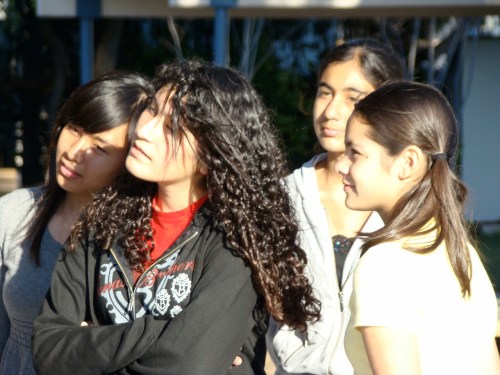
If our children need models for how not to listen they only have to look at the adults at Town Hall Meetings!  

Fortunately, our students were not likely paying that much attention to the Town Hall Meetings on Health Care.  

So I realized in that moment at the boat ramp what I have known for a very long time but never put into words…

We teach children to READ and encourage them to read because it is a life skill that will determine their success at every level… and besides… it is tested!

We teach children to WRITE and encourage them to write because it is a life skill that will determine their success at every level… and besides… it is tested!

We teach children to solve problems and encourage them to solve problems because PROBLEM SOLVING is a life skill that will determine their success at every level… and besides… it is tested!

And even though LISTENING  is a life skill that will determine our  students’ success at every level and it is one of the 4 main components of the California Standards for Language Arts (reading, writing, speaking, and listening!) … I wonder if we don’t teach it because it is not tested!!!

Are YOU listening?

listen to us

So teach students to listen:

• To LISTEN with their face and shoulders– sit up straight and face the speaker…

• To LISTEN with their eyes– look at the person speaking to you…

• To LISTEN with their mouthes closed– you can’t talk and listen at the same time…

• To LISTEN with their minds open– focussed, engaged, attentive, active listening…

• To LISTEN as if to understand– like you just asked for directions to a place you really want to go…

• To LISTEN with both ears.

Listen as if your future depends on it.  Because it does.  

Maybe naming the two rivers that flow into the San Diego Bay will not be necessary to kayak on the water today.  Maybe knowing their watershed trivia won’t determine whether our students can compete in AP classes in high school or get into USC or run a business or participate in such democratic processes as… say…. Town Hall Meetings.

But being able to LISTEN when someone is speaking most certainly will.  Whether it is LISTENING to acquire facts or trivia or information or curriculum content or important dates or directions or another person’s opposing point of view… the ability to LISTEN is no less important than the ability to read and write!

So we headed out on this warm Thursday morning– Harry the Kayak Guy, Conchita and me, and eight 7th graders determined to work as hard today on their listening skills as their paddling skills. And we started something new.  With all of the distractions of being out on the glorious open space of the San Diego Bay… with the sun and water as warm as a swimming pool… with the fish jumping and the hazy skyline in the distance and the temptation to splash water on your classmates while Harry the Kayak Guy is speaking… we know we have to give our students a chance to practice attentive listening.

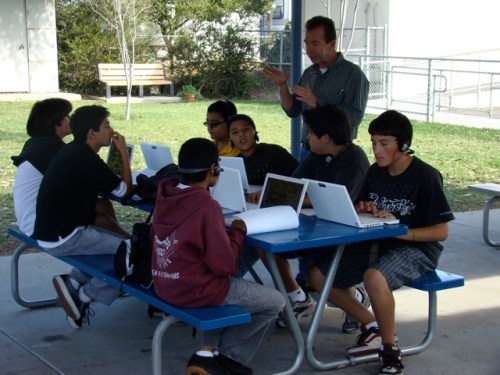
So now we have “Kayak Meetings.”  Whenever Harry the Kayak Guy is ready to instruct the students about the geography or ecosystems of the Bay, we ask that they circle up together and hang on to the kayak next to you.  There we sit out on the Bay, in science class, rocking with the waves and working to get better at LISTENING.

kayak meeting


Leave a comment

Filed under charter schools, El Milagro, environmental studies, public education, standardized testing, teaching

WHY PRESIDENT OBAMA WILL BE OUR GUEST SPEAKER AT EL MILAGRO

obamaokids

On Tuesday morning President Obama will be speaking to children in schools all across America.  He will deliver the messages that we have spent our careers delivering to our students:  stay in school.  Work hard.  Take responsibility for your education.  Do your homework.  Dream big.

He’s the perfect person to sing such a hopeful tune.  By now we all know from whence this man has come.  Born to an immigrant father from Kenya and a white mother from Kansas, he grew up, at least for a time, in poverty.  He struggled as a youth to maintain a focus on his education. But ultimately, he graduated from some of the most prestigious universities on the planet– including Harvard Law School.  He became a community organizer to parley his education into some good for others.  He served his community.  He ran for public office.  He expanded his influence.  And in one of the most inspirational stories in our nation’s long tradition of resilient  citizens, he rose above the odds to become the first African American President of the United States.

He’s the guy that wants to step into our classrooms and tell kids that if they work hard and persevere and not make excuses they too can achieve their dream.  He’s an orator.  He is a poet.  He is compelling.  He is engaging.

Tuesday morning when the sun rises on the first day of school across most of America, children will meet their new teacher and new classmates and the televisions will click on and the President will welcome them back.  At least some of them.

gunzjpegAs is the case with all things now in American politics, this too has been spoiled.  The President has been demonized and his intentions sullied by another fight.  The same group of unhinged people who question our President’s legitimacy as an American citizen (Dred Scott?), who challenge his authenticity as an elected official, who carry guns to his public appearances, who freely and publicly characterize him by the twin hot button n-words: “nigger” and “nazi”, who muse that he “is not one of us”, who simultaneously suggest he wants to kill our elders… now suggest he wants to get his hooks into our children’ minds. Christians… sowing the seeds of hatred.

beckKnuckleheads from the far (and not so far) right wing of the Republican Party have managed to cast so many shadows on the President’s address to school children, that most will never hear the message.  Even elected officials have gone so far as to suggest that the president intends to use his “bully pulpit” to foment socialism and spread his radical ideologies  to an unsuspecting captive audience of school kids who just want to know where to store their lunch pail in their new classrooms. 

“As the father of four children, I am absolutely appalled that taxpayer dollars are being used to spread President Obama’s socialist ideology. The idea that school children across our nation will be forced to watch the President justify his plans for government-run health care, banks, and automobile companies, increasing taxes on those who create jobs, and racking up more debt than any other President, is not only infuriating, but goes against beliefs of the majority of Americans, while bypassing American parents through an invasive abuse of power. While I support educating our children to respect both the office of the American President and the value of community service, I do not support using our children as tools to spread liberal propaganda.”  —  Jim Greer, GOP Chair, Florida

“As far as I am concerned, this is not civics education — it gives the appearance of creating a cult of personality. This is something you’d expect to see in North Korea or in Saddam Hussein’s Iraq.” — Oklahoma Republican State Senator Steve Russell

North Korea?  Are you freakin’ serious?

What is it about these people?  How far does their hypocrisy go?  I remember when their guy was in office… if you questioned his judgment (?)  or direction you were no less than a traitor to America.  I remember him trying to string two coherent sentences together on any topic.  I remember all the members of his party suddenly running for office on the “family values” ticket… then demonstrating none of the values most families I know would ever espouse.  

I remember their education showhorse called No Child Left Behind.  It was going to spur school reform in America once and for all.  It was going to resurrect our schools and get us back to the basics.  We would be able to expose those schools that aren’t taking care of children– fire the teachers and the principals and allow parents to cut bait if need be and send their kids to schools that were really teaching.  We would even close the achievement gap across racial and socio-economic lines.  And the truth would be told in test scores.

And it was.  And the truth is that No Child Left Behind was never intended to close the achievement gap nor improve the quality of public education for children in all communities across America– which may explain in part why it has done neither.  

So while parents fret over whether they should “allow their child to be exposed to the message from the White House” on Tuesday– the irony is most schools won’t have time to air it anyway.  

And the “lesson plans” and other prepared materials designed to assist teachers in framing class discussions after the President’s address?  The one’s that really have created a collective aneurism among Republicans?  The ones that actually have the audacity to challenge kids to think… that prompts them with such radical questions as “How might you help the president?”  

I can guarantee that schools won’t have time to delve into those either. They will be far too busy with drilling students on basic skills and jumping through the hoops crafted by NCLB.  They will be preparing students to answer the standardized test questions that they will confront in May.  

obamaWhat a shame.  What a loss for those children and their naive parents.  They will miss the point that Barack Obama did not rise to the station of the American Presidency because he can take standardized tests or survive a curriculum so narrowly tuned to reading and math.  He rose to the presidency because he can THINK. He is a reader, a writer, an orator, a lover of art and music and people.  He is a leader.  Spiritual.  Self disciplined and self made.  He is the embodiment of Gardner’s Multiple Intelligences. He is the very model of what our public schools should strive for. And perhaps that is the biggest fear of all for those on the right:  That our public schools might actually work!  That we might, if untethered from the yoke of mindless standardized testing, reach across the great socio-economic divide and actually raise children from every community and race and ethnicity and gender group– to compete.  Anywhere.  Against anybody. Even to be President of the United States.

DSC_0260This Tuesday the televisions will be on at El Milagro.  We told teachers if they can fit it into their schedules they should.  But it is up to them.  And if parents don’t want their children exposed to this man…  they can opt out.  It is their call.  Their conscious. They can be complicit in the very blatant educational malpractice that began during the Bush presidency if they so choose.  Or they could actually seize the teachable moment and model for their own children that rarest of gifts these days:  the ability to THINK for oneself.

political-pictures-barack-obama-library-cool


6 Comments

Filed under El Milagro, President Obama, public education, resiliency, school reform, standardized testing

THE LION

tedjpegThe lines draw to the heavens today… and I am paying attention.
Jose-01The Space Shuttle Discovery has ascended into orbit after long last, carrying the hopes of NASA– but also the son of migrant farm workers. Jose Hernandez picked cucumbers in Stockton as a child. Today, he is among the Latino community’s most distinguished members, circling our planet as an astronaut on his first tour in space.

And yet, at the exact same moment, our nation celebrates the life of the very senator that made Jose Hernandez’ journey possible. The Lion. Asleep now to us and for the moment surrounded by our nation’s most powerful leaders, he is bound for eternal rest with his two brothers. These Kennedy’s were my family’s patron saints. They were the source of my idealism. In their quest to pave the way for sons of farmworkers and daughters of former slaves, they changed the face of our nation. They compelled us all to live our lives in the service of others.

Senator Kennedy fought for heath care and education, social justice, and the journey of the poor. He survived the tenure of 10 presidents, beginning with his own brother’s. In over 4 decades of political battles, he wrote over 1000 laws and bills so that the civil rights of all Americans might come to full fruition. He stood for our nation’s defense. And world peace.

He fought so that there would one day be a seat on rocket ships for the likes of Jose Hernandez and the children of El Milagro. And like his brothers before him, his passions were crystallized in the Catholic tradition, as if Jesus himself approved. And he surely would.

processionIn his passing, the media has focused intently on his life. The good and the bad. The public giant, the private man. The triumphs– and the darkest hours inevitably shared on a bright bright stage. The long march to Arlington behind the riderless pony and our fallen President. That amazing euology for Bobby that has echoed for 40 years. The one that inevitably tantalizes us to pause in deep reflection, to think– if Jack and Bobby had lived a full life… what might have been.

Images of my childhood.

My own father passed in 1986. My mother just two years ago. Today would have been her 85th birthday. She would have sat in front of the television like she had for all the Kennedy funerals, rosary in hand. Holding on to her emotions until the floodgates opened with the “Ave Maria”. Tears streaming for Irish patriots.

obama and tedThe symbolism and powerful metaphors would not have been lost on her. The Latino astronaut circling above. The new President delivering another eulogy for the ages. Young. Handsome. African American. Beneficiary of all those who came before to pave a road, however narrow, toward real equality—but especially Ted Kennedy.

To tell you the truth, I’ll feel better when the Discovery and our new President are safely home. There is risk in soaring. No one knows that better than this noble family. But of course, our greatness comes only from those willing to rise above the expectations and the odds, above the bigots and the small minded… above the politics and the fear.

There is less celebration here on earth today than there is in heaven. The last brother has made it home. He said of Bobby:

“My brother need not be idealized or enlarged in death beyond what he was in life. But to be remembered simply as a good and decent man, who saw wrong and tried to right it, saw suffering and tried to heal it, saw war… and tried to stop it.”

Today, all earthly powers have one eye on the heavens and the sleeping Lion. “But the work goes on. The cause endures. The hope still lives. And the dream will never die.”

3 brothers

3 Comments

Filed under El Milagro, health care, President Obama, public education