
 We are two weeks from the 2009 iteration of the California Standards Test. The clock is ticking. We are prepared. We are in a zone. And we better be…considering the high stakes.
High stakes? Isn’t that just residual hyperbole left over from the NCLB-era politics? Well let’s check it out.
Here are a dozen ways that standardized testing has resulted in high “stakes” outcomes and their unintended consequences:
• High stakes because the results are going to follow every student for the remainder of their school careers.
• High stakes because schools will use the results to determine students’ eligibility for after-school programs and tutoring opportunities and Advanced Placement classes and extracurricular activities. Even for eligibility (and thus in-eligibility) for participation in athletics and the performing arts.
• High stakes because school officials will use the scores as a criteria for classifying children as gifted– public education’s most coveted label. Similarly, they will cite these scores when diagnosing children as learning disabled.
• High stakes because schools will (illegally) weigh the portents of these scores before admitting new students. Or they will consult them– the final straw– before expelling or disenrolling kids; before recommending ‘delinquents’ to a continuation program or independent study or homeschooling or some other version of learning in Siberia.
In high stakes testing, the results matter to everybody.

• They are “high stakes” because presidents and governors and mayors run for elected office on the promise of improving local trends in standardized test scores. School board members too. And the superintendents that school boards hire will survive on their ability to deliver higher scores on metrics like the Academic Performance Index (API). Likewise the principals that the superintendents hire will come and go like bad wind and pretty much everybody will feel the pressure when the next wave of leaders are clearing out their desks and insuring their colleagues that they have always wanted to return to the classroom.
• High stakes because that pressure to raise test scores will drive teachers with the most seniority (and experience) toward the schools with the higher API (800+) and lower stress levels.
 • High stakes because schools with low API’s (<700) will continue to replace those migrating veteran teachers with brand new inexperienced teachers who will take five years to learn their craft… and then they will migrate too. And while they are learning, those younger teachers will be just starting to raise families of their own. So you can expect those teachers to be out two to three months on maternity leave and to be temporarily replaced by long-term substitute teachers who have less training and less experience than the inexperienced young teacher they are replacing.
And the community will witness the invisible forces of the high stakes tests in ways they could never imagine.
• High stakes because when educated, upwardly mobile young couples start looking for a suitable neighborhood in which to raise their families they inevitably consider the quality of the schools. They consult websites like greatschools.net and identify the school districts with the highest test scores. And that is where they buy their home.

• High stakes because when large groups of young, upwardly mobile couples get together to raise their children, they insist on state of the art pre-schools and they start volunteering in the elementary school before their kids are old enough to walk. So a whole community evolves around a culture of high achievement. It becomes pre-ordained and the Academic Performance Index of the schools go even higher.
• High stakes because the schools with low API’s struggle for any organizational momentum at all. They tend to serve families who are less educated and thus less upwardly mobile. They tend to serve families that are in survival mode. They do not tend to attract the new young families who just moved to town and who are looking for the very best schools.
• High stakes because the communities with large clusters of well educated and upwardly mobile families experience far fewer home foreclosures than those where families took greater risks with loans. (In San Diego County, for example, the top five zip codes with the highest number of home foreclosures featured schools with an average API of only 754.) Home foreclosures lead to higher student mobility rates as families migrate toward more affordable housing options.
High stakes.
 • High stakes because we are all compelled to strike hard against the mountainous challenge of quantifying children’s learning on the basis of a single standardized test. We will balance the winners and the losers and the inevitable damage caused when the best of intentions collide with unintentional consequences. And that is, by definition, high stakes– where our systems align poorly or not at all. And for that incongruence…our children pay.
In California, there are only two weeks remaining until we administer the next version of the CST. When it is complete, we will dutifully send our thousand student answer sheets off to Sacramento with a blind faith that they will be accurately scored. And the cycle of waiting for the results and the early analyses will begin anew.
Our students are ready to play the game. It is high stakes. We are “all in”.

 This is also the time period in which we cease to philosophize about the wisdom of standardized tests and what the pre-occupation with language arts and math might be doing to our students’ broader abilities to think and innovate and solve problems and reason. This is not the time to engage in the political debate. An NFL coach may not like the rules for sudden death overtime, but when you are out of downs on your opponents’ 20-yard line, you better just trot out your kicker for the game winning field goal and argue about the rules of the game later.
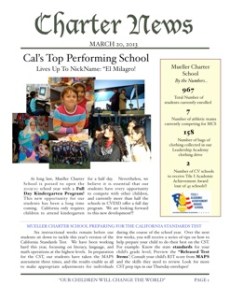
 So we are playing to win. And when we win, we expect that there will be some interesting headlines in the morning newspaper. Something like:

 This happened on the last President’s watch, the one that talked about patriotism and Christian values and keeping America safe. The one that imposed No Child Left Behind on America’ s schools and accelerated an era in which the illusion of accountability and achievement has merely driven schools to gun the motor, spin the tires in the mud, and lurch forward in the wrong direction in a cloud of spent energy and system-wide exhaustion. Just like the economy. President Obama said:
 The second study came from the National Center on Family Homelessness who now estimate that one in every 50 American children is homeless. In summarizing the report
 Twitter the whales. That’s what you do when they are left out of the curriculum. At least that is what connected parents are doing.
 For example: this week I was asking Kira about her Marine Biology class. Although her college is 5 miles from the Pacific Ocean, they will not once visit the tidepools or watch the annual migration of the gray whales or stop by the
  Aren’t these university professors–these giants of the trade– reading their colleague’s stuff. Marzano? Bloom? Gardner? Freire? Cooperative learning?




 I celebrated another birthday this week and I realize with each passing year how much I have learned in my life. Every day, every week, every year. And the lessons keep coming. But the ultimate lesson of where we all go from here– no matter how deeply I reflect– I can never quite resolve. I only know that we are here and we are gone. And that somewhere our spirits and our souls are transformed and we slip quietly out of view of those we leave to the Earth.
 This weekend, we are all on the precipice of such a moment. One that stirs our history and our hopes. There is an unmistakable spiritual presence emerging even while our nation reels from conditions that might otherwise seem awfully bleak. In three days, we will arise and walk again.
 This week, as he braces for Inauguration Day and the ride of a million lifetimes, Barack Obama published
  So for his part, Barack Obama has merely ascended to the most difficult job on the face of the earth– to become the most powerful living human being– to make the world a better place for the daughters he loves so dearly. He has risen above paralyzing political divisions for the opportunity to change the course of America. To become president, he merely had to transcend centuries of racism, intractable prejudice, and a tortured national history of self-hatred that manifests itself in bigotry and intolerance.





 "El Milagro Weblog"