
 Corporate CEO’s and forward thinkers like to use the Wayne Gretzky analogy. Gretzky scored 940 some goals in his 20 career in the NHL. But he never skated to the puck in order to take his magic shots. If he skated to a hockey puck angling off the boards at 100 mph, it would be gone by the time he got there. So Gretzky was as good as any hockey player that ever played the game… at skating to where the puck was going to be.
That’s forward thinking. Broad vision.
 So in light of the Wayne Gretzky analogy, this week’s lead story in TIME Magazine is reassuring. California, it seems, is not falling off into the Pacific Ocean after all.
Oh sure, there are earthquakes and wildfires and crazy environmentalists chaining themselves to the railroad tracks in defense of the ecosystem. There are gangs and home foreclosures, long unemployment lines and long lines at the frenzy-producing freeway merge. There may be shuttered businesses and legions of workers whose origins are driving Lou Dobbs nuts.
But in general, there is enormous up-side in the Golden State and its powerhouses of innovation that are skating to where the puck is going to be.
Michael Grunwald writes:
It’s still a dream state. In fact, the pioneering megastate that gave us microchips, freeways, blue jeans, tax revolts, extreme sports, energy efficiency, health clubs, Google searches, Craigslist, iPhones and the Hollywood vision of success is still the cutting edge of the American future — economically, environmentally, demographically, culturally and maybe politically. It’s the greenest and most diverse state, the most globalized in general and most Asia-oriented in particular at a time when the world is heading in all those directions. It’s also an unparalleled engine of innovation, the mecca of high tech, biotech and now clean tech. In 2008, California’s wipeout economy attracted more venture capital than the rest of the nation combined. Somehow its supposedly hostile business climate has nurtured Google, Apple, Hewlett-Packard, Facebook, Twitter, Disney, Cisco, Intel, eBay, YouTube, MySpace, the Gap and countless other companies that drive the way we live.
Innovation implies the flourishing of ideas that haven’t even been launched yet, defying the status quo. It rewards early adopters and those who integrate technology in the most unlikely of ways. Like Kogi, writes Grunwald, the Korean taco truck that announces its location via Twitter. “The beauty of California is the idea that you can reinvent yourself and do something totally creative,” says Kogi’s Roy Choi, a former chef at the Beverly Hilton. “It’s still the Wild West that way.”
But as forward leaning as the TIME Magazine piece on California is, it missed a chance to recognize that our schools have also evolved at light speed from the Fast Times at Ridgemont High.
When Grunwald celebrates the culture of innovation that produces breakthroughs in chip-industry, solar, LED lighting, green materials, the digitized grid, biotech, algae-to-fuel experiments, synthetic genomics, carbon-capturing-cement, sugar to diesel, semiconductors, and energy-efficient windows… he could have been a game changer himself… the first to recognize the relationship between innovative public schools and the fast companies they serve. Instead, he states that California public schools “pose a real obstacle to the dream of upward mobility” and that they have been “deteriorating for years.”
Really? Deteriorating? You are clearly thinking of Spicoli’s public schools. Not mine!
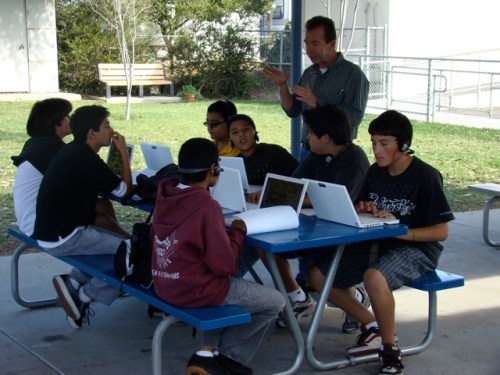
California passed its charter law in 1992, one of the first states in the country to do so. There are now 750 charter schools serving 276,000 kids. 90 new charters opened in 2007 alone. There are charters of every kind from High Tech High to El Milagro. They flourish in a state that is unique for its size and diversity. Where 64% of its student population are children of color… third, only behind Washington DC and Hawaii. A state where nearly half the students qualify for free or reduced lunch and where 1 out of 4 are English language learners. A state that invests only $9,152 per student (while New York invests $15, 981 per student). And where we don’t make excuses.
And while other states are relaxing their standards or lowering the cut point that determines grade level proficiency, California remains one of the most difficult states in America to test out at grade level. The expectations here are sky high.
There are still many underperforming schools… but I don’t know where they are. And if I did, I wouldn’t defend them.
I do know however, that schools like El Milagro continue to compete in an environment that is destined to change. We will not be able to sustain schools as test prep academies to the exclusion of the real skills and talents that will feed into our innovative industries. Solving energy and the riddles of biomedicine can not come from multiple choice tests. The future demands creativity. Critical Thinking. Resilience.
So you can be sure there are schools like mine, skating to where we envision the puck will be. That’s California too. Revolutionary thinking and the wild, wild west.
 Warning!
 So we peeked over the fence at what those other schools were doing. We infiltrated their ranks. We looked at the materials they were using and snuck in their classrooms and took pictures. We even bought them lunch and straight-out asked them: “What the hell are you doing to get those results?”
 So that brings us to three girls from Ms. Etter’s class that I worked with this past week.
 And even though Cassandra is Far Below Basic and not likely to improve significantly enough to get to grade level this year… if we can move her up at least one proficiency level, it would be a huge gain for her. Then, if we can move all of Cassandra’s Far Below Basic classmates up it would be good for them too. And good for our API. Because if Mueller Charter School was so aligned that we did not have any Far Below Basic students last year… our API would have been up as high as 815.


 The International Olympic Committee decided to hold their 2016 Games in Rio instead of Chicago. Even a personal appeal by President Obama could not persuade them otherwise.
 The IOC was evidently not disuaded by the poverty, crime, pollution, corruption and violence present in Rio. After all, it is not like those conditions don’t exist in Chicago.
 And as sobering as that data may be, Derrion Albert was not the victim of random gun violence in Chicago! He was hit over the head with a splintered railroad tie in the middle of a street melee, and then he was punched and kicked unconscious. He was not a participant. He was merely walking home from school. While he lay in the street dying,
  This is not the first time large expenditures have gone into the public schools to try to keep our children safer. Back in the early 1990’s, Walter H. Annenberg established the Annenberg Foundation with $1.2 billion in assets, explained that he made his historic commitment to school reform because he was concerned about rising violence among young people: “We must ask ourselves whether improving education will halt the violence.”
 Mueller Charter School is a finalist for California’s prestigious Golden Bell Award. That is significant. It’s a big deal.
  Significant because it signals an appreciation for the inherently complex nature of teaching, and how real reform cannot come to our schools unless we overcome (or at least neutralize) the many crises in our communities that affect our students. And that takes innovation… finding a new way. President Obama has urged that we stop treating unemployment, violence, failing schools, and broken homes in isolation and put together what works “to heel the entire community”. Like the
 Monday, September 21st, is the United Nation’s 27th annual attempt to promote an

 This is the
 And one student tugged at his tennis shoe while two girls continued their conversation and a third girl looked out toward the San Miguel Mountain with her eyes fixed on absolutely nothing and two boys pretended to swat each other with their paddles and one child appeared to absolutely strain to come up with a respectable answer for Harry the Kayak Guy.
 After all, wasn’t it just this past month that we all witnessed full-grown Americans yelling at each other and threatening and pointing fingers and waving guns and shouting with spit flying and jugglars bulging? Their anger and incivility prevented all meaningful discourse.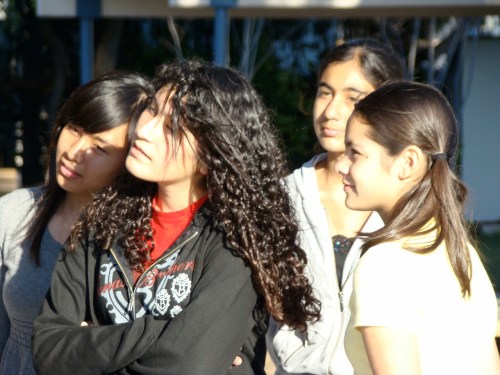


 As is the case with all things now in American politics, this too has been spoiled. The President has been demonized and his intentions sullied by another fight. The same group of
  Knuckleheads from the far (and not so far) right wing of the Republican Party have managed to cast so many shadows on the President’s address to school children, that most
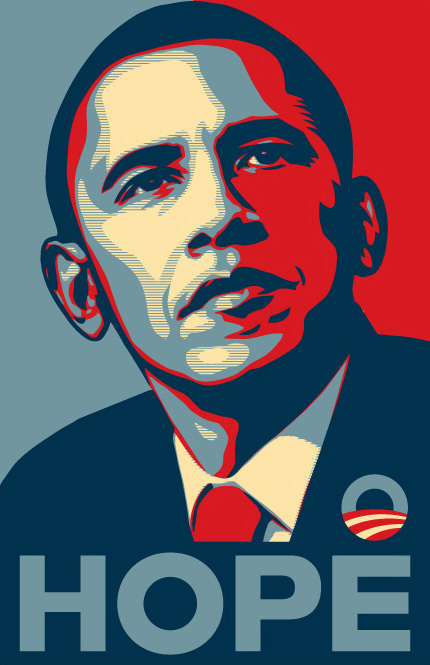
  What a shame. What a loss for those children and their naive parents. They will miss the point that Barack Obama did not rise to the station of the American Presidency because he can take standardized tests or survive a curriculum so narrowly tuned to reading and math. He rose to the presidency because he can THINK. He is a reader, a writer, an orator, a lover of art and music and people. He is a leader. Spiritual. Self disciplined and self made. He is the embodiment of Gardner’s Multiple Intelligences. He is the very model of what our public schools should strive for. And perhaps that is the biggest fear of all for those on the right: That our public schools might actually work! That we might, if untethered from the yoke of mindless standardized testing, reach across the great socio-economic divide and actually raise children from every community and race and ethnicity and gender group– to compete. Anywhere. Against anybody. Even to be President of the United States.
 This Tuesday the televisions will be on at El Milagro. We told teachers if they can fit it into their schedules they should. But it is up to them. And if parents don’t want their children exposed to this man… they can opt out. It is their call. Their conscious. They can be complicit in the very blatant educational malpractice that began during the Bush presidency if they so choose. Or they could actually seize the teachable moment and model for their own children that rarest of gifts these days: the ability to THINK for oneself.
 The lines draw to the heavens today… and I am paying attention.
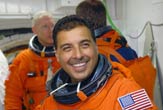 The Space Shuttle Discovery has ascended into orbit after long last, carrying the hopes of NASA– but also the son of migrant farm workers. Jose Hernandez picked cucumbers in Stockton as a child. Today, he is among the Latino community’s most distinguished members, circling our planet as an astronaut on his first tour in space.
 In his passing, the media has focused intently on his life. The good and the bad. The public giant, the private man. The triumphs– and the darkest hours inevitably shared on a bright bright stage. The long march to Arlington behind the riderless pony and our fallen President.
  The symbolism and powerful metaphors would not have been lost on her. The Latino astronaut circling above. The new President delivering another eulogy for the ages. Young. Handsome. African American. Beneficiary of all those who came before to pave a road, however narrow, toward real equality—but especially Ted Kennedy.
 This past week I contributed a sort of reprise on my “My I-Phone is Smarter Than Your Kid’s Teacher” post. Still!
 So I wondered whether some educators are unable to distinguish between entertaining kids and engaging them. Or, put another way, whether they think you have to entertain them to engage them.




 "El Milagro Weblog"