Category Archives: teaching

THE TURN-AROUND PLACE

Allen Odden is a professor of educational leadership and policy analysis at the  University of Wisconsin-Madison who claims to know how to turn around low achieving schools.  In fact he wrote a book about the topic called “Ten Strategies for Doubling Student Performance”.  He doesn’t work in schools, he studies those of us who do.  So his premise is that school turnarounds are not a new phenomenon and that “we”  know how to fix them, and “we know how to literally double student performance in low income schools, and in the process take huge chunks out of the achievement gaps that separate students along racial and socioeconomic lines.”

In a recent article in Education Week entitled We Know How to Turn Schools Around, Odden identifies 10 core elements he picked up from studying schools just like El Milagro.  Here is Odden’s checklist:

ONE: Create a sense of urgency.

TWO:  Set ambitious goals: (e.g.; to double student performance on state tests, to double the percentage of students scoring at advanced levels, to make sure that no student performs below the basic level at the end of 3rd grade, and that all students leave that grade reading on level.)

THREE:  Throw out the old curriculum and adopt new textbooks, create new curriculum programs, and start to build, over time, a common understanding of effective instruction.

FOUR. Move beyond a concentration on state tests and use a battery of assessments, including formative and diagnostic assessments, common end-of-curriculum-unit assessments, and benchmark assessments.  All of these enable teachers to make midcourse corrections and to get students into interventions earlier.

FIVE:  Create and implement an intensive and ongoing professional-development program. (The best schools form collaborative teacher teams— aka, professional learning communities—that meet often, make use of student data, and work with school-based coaches to improve curriculum and instruction.)

SIX:  Provide extended learning time and extra help for all students to attain proficiency. (e.g., Some combination of one-on-one or small-group tutoring for struggling students, together with extended-day and summer programs that emphasize providing academic help.)

SEVEN: Use time effectively. (Core instructional time for reading, math, and increasingly science is protected from intrusions; each minute is devoted to teaching the class. Literacy time often is extended to 90 to 120 minutes a day.)

EIGHT:  Teachers lead grade- and subject-based professional learning communities. Most of the instructional coaches are the school’s best teachers, and they orchestrate the overall professional-development system. And principals provide real instructional leadership.

NINE: Staff members read the most recent research, reach out to experts in the field, look for and use best practices, and take responsibility for assessing the impact on student learning of what they do, improving instructional practices when student results are not what’s desired.

TEN:  Recruit the talent needed to accomplish lofty goals and implement the collaborative and powerful educational strategies discussed here.

Ok.  So that is his list.  It just so happens that at El Milagro we have been down the path on all 10 core elements.  They are in place. Maybe that is why we have never missed an AYP goal, never missed a year of positive gains on the API, and recently been named a Title I Academic Award Winning School in the state of California.  Or maybe our success has come from going even deeper when initiating school reforms.

There are three problems with the good professor’s premise:

First, it assumes that a “turn around school”  is one that is getting better test scores.  But  perhaps the bigger challenge in school leadership is protecting kids from the craziness of schools obsessed with higher test scores– while still getting higher test scores! It is harder to get results when you refuse to become a test prep academy or when your school still values the meaningful extracurricular activities that don’t always directly tie in to testing (like athletics, theater, the arts, and music).

Secondly,  this article (and the publication of his book!) assumes a college professor has some authority on an issue he has “studied”… as opposed to a having actively engaged in the work of really turning a school around!  It is much like hiring a sports writer to coach an NFL team to the Superbowl or a film critic to create an academy award winning movie.

Finally, in concentrating on these broader, more obvious initiatives that we already stumbled across years ago… Odden’s list misses (at least )10 core elements that run even deeper into the DNA of a successful school.  For example, we have found that to turn a school around and sustain long term, continuous improvement, you must:

• Strike a BALANCE between raising students and raising test scores

• ENGAGE CHILDREN  in their own learning and growth; help them to be experts in analyzing their own test data and set goals accordingly

• Lead parents in a community transition from parent involvement to PARENT ENGAGEMENTwhere parents’ energy is first and foremost directed toward helping their child be a successful learner

• Integrate successful TECHNOLOGY solutions that bridge the digital divide and simultaneously accelerate learning

• Create systems that support STUDENT WELLNESS (academic, social, emotional, mental, medical, dental), especially for students who are otherwise at high risk

• Promote healthy NUTRITIONAL HABITS  and a climate that promotes daily exercise

• Maintain a BEHAVIOR POLICY  that is clear, democratic, humane, and prudently applied (as opposed to “zero tolerance”)

• Promote COMMUNITY SERVICE and each students’ capacity for contributing to others

• Create a sense of individual EFFICACY  among staff and students

• Foster RESILIENCY in individuals and in the school organization as a whole.

Those are my ten.  For now. There will be more innovations for professors to study in how we turn our schools around.
2 Comments

Filed under charter schools, El Milagro, innovation and change, public education, resiliency, school reform, standardized testing, teaching

WHAT IF HOPE WAS A NATIONAL PROMISE?

So we are down in Georgia attending a community charity event for Intuit. I didn’t bring my laptop so I am writing this post from my phone. No pics today… just this thought: what if the “free and public education” system extended into college? Like here in Georgia.

Clay told me that every graduating senior in the state is eligible for the Hope Scholarship; if they maintain a minimum GPA, and get accepted into a university in Georgia, all tuition is covered!

An awesome program. I wonder how many states offer their kids the same promise? How many kids take advantage of it? How far has it gone to bridge the sociology-economic divide? How do high schools tap into the grant and get their students on college campuses EARLY?

I wonder… what if the $30 billion a week spent on war…  or the $ trillion-plus investment into the pentagon… or the one million dollar a year per soldier… was invested here… for our kids… in our universities… to make college affordable; To make colleges and universities more accountable for the quality of their teaching? Like K-12 schools. No College Kid Left Behind.

2 Comments

Filed under college, El Milagro, innovation and change, post-secondary education, public education, teaching

THE GUNPOWDER CHRONICLES, Part 4: “Are You Listening?”

turtle 2-1This is the 4th in a series about our partnership with the Chula Vista Nature Center at Gunpowder Point. These posts will document our progress as we move our middle school science program off campus– to a satellite classroom called the San Diego Bay!


huddle

Kids don’t listen.  That is my big learning for the week.

Maybe I ‘ve always known that kids don’t listen.

But this past Thursday morning, eight 7th graders from our Nature Center program met at the Chula Vista Boat Ramp and proved it.  They could not have picked a more beautiful morning to kayak.  The sun was fully above the San Miguel mountain by 8:00am when we met Harry the Kayak Guy. The marina was perfectly still. Tranquil. There were the typical cast of sea-birds calling, the lappingof the water, a distant horn… but otherwise all was serene.

Harry the Kayak Guy had finished the routine pre-boarding instructions:  how to hold the paddles properly and how to fit their life preserver and how to get back on the kayak if they fall off and which direction is North and which fish they’ll see jumping out of the water and the many different theories for why they jump out of the water…

Then he veered from the script.  

“There are two rivers that flow into the San Diego Bay… the Otay River from the south and the Sweetwater River from the north.  Can you say those rivers?”

To which our eight 7th grade students responded with a unanimous and puzzling silence.  So he prompted them a little.

“Can you say the two rivers… that flow into the San Diego Bay… that I just mentioned…?”

artAnd one student tugged at his tennis shoe while two girls continued their conversation and a third girl looked out toward the San Miguel Mountain with her eyes fixed on absolutely nothing and two boys pretended to swat each other with their paddles and one child appeared to absolutely strain to come up with a respectable answer for Harry the Kayak Guy.

“The…  two rivers…” he started to say…

Then I interrupted.

“Alright, eyes on Harry the Kayak Guy. He just asked you a question…  can anybody even tell me what that question was?”

And having struck out on the two river question, our eight 7th grade students now looked me straight in the eyes and sheepishly admitted with their blank expressions that they not only did not know the name of the rivers that he just told them about but they hadn’t listened to his question either!

I was surprised and I was not surprised at all.  

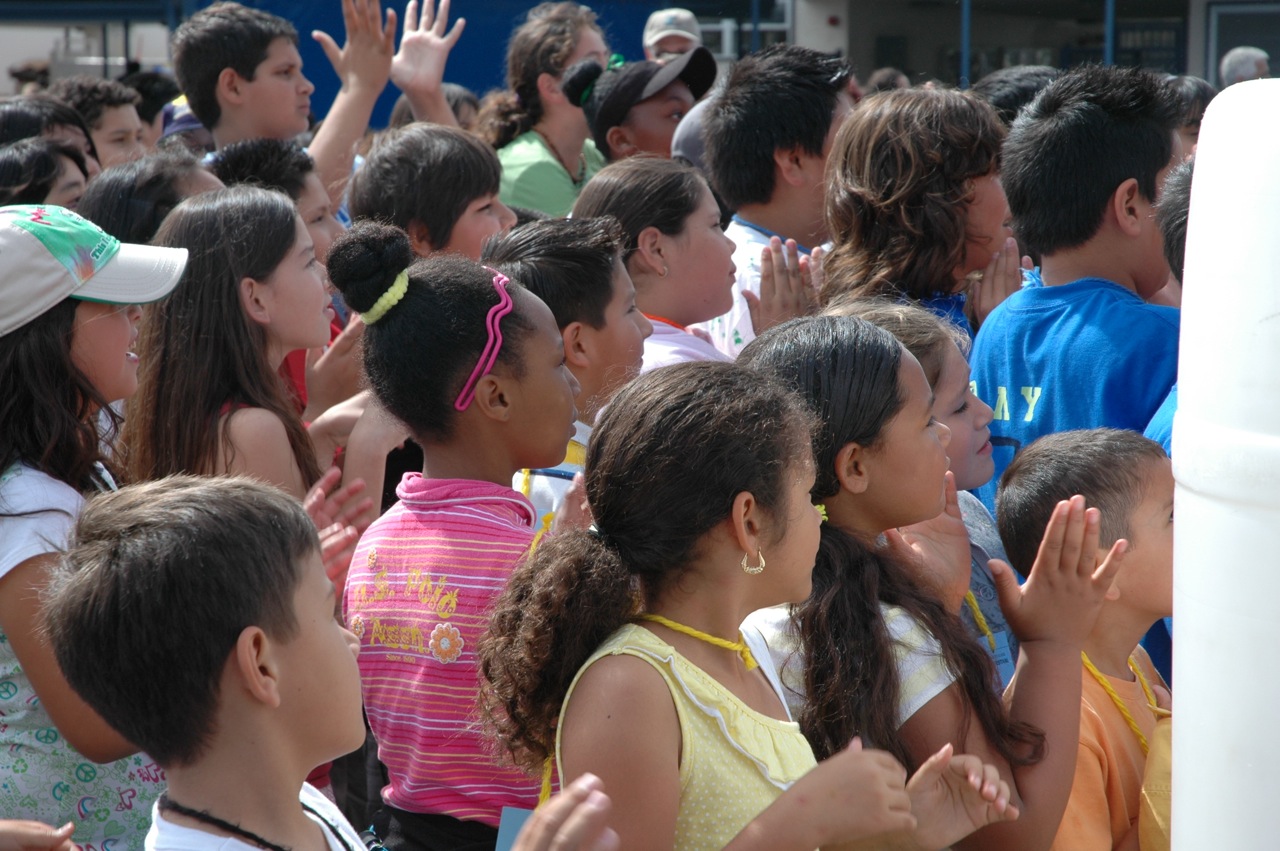
Our kids don’t listen.

But neither do the adults.

42-17772388After all, wasn’t it just this past month that we all witnessed full-grown Americans yelling at each other and threatening and pointing fingers and waving guns and shouting with spit flying and jugglars bulging? Their anger and incivility prevented all meaningful discourse.  
If our children need models for how not to listen they only have to look at the adults at Town Hall Meetings!  

Fortunately, our students were not likely paying that much attention to the Town Hall Meetings on Health Care.  

So I realized in that moment at the boat ramp what I have known for a very long time but never put into words…

We teach children to READ and encourage them to read because it is a life skill that will determine their success at every level… and besides… it is tested!

We teach children to WRITE and encourage them to write because it is a life skill that will determine their success at every level… and besides… it is tested!

We teach children to solve problems and encourage them to solve problems because PROBLEM SOLVING is a life skill that will determine their success at every level… and besides… it is tested!

And even though LISTENING  is a life skill that will determine our  students’ success at every level and it is one of the 4 main components of the California Standards for Language Arts (reading, writing, speaking, and listening!) … I wonder if we don’t teach it because it is not tested!!!

Are YOU listening?

listen to us

So teach students to listen:

• To LISTEN with their face and shoulders– sit up straight and face the speaker…

• To LISTEN with their eyes– look at the person speaking to you…

• To LISTEN with their mouthes closed– you can’t talk and listen at the same time…

• To LISTEN with their minds open– focussed, engaged, attentive, active listening…

• To LISTEN as if to understand– like you just asked for directions to a place you really want to go…

• To LISTEN with both ears.

Listen as if your future depends on it.  Because it does.  

Maybe naming the two rivers that flow into the San Diego Bay will not be necessary to kayak on the water today.  Maybe knowing their watershed trivia won’t determine whether our students can compete in AP classes in high school or get into USC or run a business or participate in such democratic processes as… say…. Town Hall Meetings.

But being able to LISTEN when someone is speaking most certainly will.  Whether it is LISTENING to acquire facts or trivia or information or curriculum content or important dates or directions or another person’s opposing point of view… the ability to LISTEN is no less important than the ability to read and write!

So we headed out on this warm Thursday morning– Harry the Kayak Guy, Conchita and me, and eight 7th graders determined to work as hard today on their listening skills as their paddling skills. And we started something new.  With all of the distractions of being out on the glorious open space of the San Diego Bay… with the sun and water as warm as a swimming pool… with the fish jumping and the hazy skyline in the distance and the temptation to splash water on your classmates while Harry the Kayak Guy is speaking… we know we have to give our students a chance to practice attentive listening.

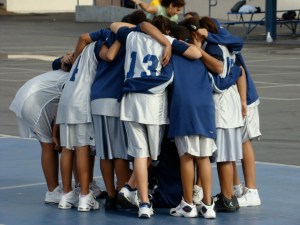
So now we have “Kayak Meetings.”  Whenever Harry the Kayak Guy is ready to instruct the students about the geography or ecosystems of the Bay, we ask that they circle up together and hang on to the kayak next to you.  There we sit out on the Bay, in science class, rocking with the waves and working to get better at LISTENING.

kayak meeting


Leave a comment

Filed under charter schools, El Milagro, environmental studies, public education, standardized testing, teaching

THE GUNPOWDER CHRONICLES, Part 3: “Kayaks”

turtle 2-1This is the 3rd in a series about our partnership with the Chula Vista Nature Center at Gunpowder Point. These posts will document our progress as we move our middle school science program off campus– to a satellite classroom called the San Diego Bay!

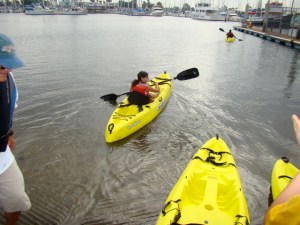
across the bayOn Tuesday we launched seven of our 8th grade girls into the bay.  The Nature Center is an extraordinary lab for studying the the marshes and reservoirs and natural bayfront ecosystems, but nothing compares to being in the water itself.  Splashing through the mud-decked channels in the shadows of the powerplant.  Battling the currents.  Reading the tide.  Checking the waterproof bird guide against strange-beaked egrets and massive herons.  
So that’s where we went.

Harry owns Chula Vista Kayaks and he is our partner in our effort to get all of our middle school students out on the water at least once every quarter.  Just about anybody can paddle a kayak.  They are stable and low to the tide.  You get wet.  You feel the water.  You smell the exposed shells baking even on cloud-covered mornings like this.

into marinaSo we launched from the boat ramp: Harry, seven students, Conchita (our office manager)  and me.  Into the calm marina, out past the last moored pleasure boats, a hard left around the jetty, and into the open bay.  The day before we had taken seven of the boys so we anticipated a :30 minute paddle across the water to reach the isolated channels on the other side.

Sometimes when you are teaching kids you can anticipate stuff like that.  But then there are those lessons you could never have anticipated.  There are those lessons that end up being far more instructive to the teacher than they could ever be for students.  Like on this morning.  On San Diego Bay.  With seven middle school girls in kayaks.  

The first four students got the hang of paddling instantly and powered across the water with Harry and Conchita. Vanessa had started off with the others, but rapidly ran out of gas and fell off the pace. The last two struggled to paddle at all, and the tide immediately pushed them sideways closer and closer to the rocks of the jetty.  They had no technique.  No basic skills.  

As an intermediate level kayaker, jettyI could model the technique for them.  And so I did.  But they still pushed close to the rocks.  So I tried to explain the technique– but now their kayaks were relentlessly  pressing against the jetty edge.  Then I tried to encourage them… but my voice was muffled by the momentary panic, the surging water, the steady roar, the helpless on-lookers.

But in the end, this is a bay– not some 10-foot crashing surfline along the ocean cliffs– so eventually the girls were able to turn their kayaks into the current and push away.  They were finally free of the jetty and  into the open water.  So we were back on course,  some 800 yards behind the others. I offered to turn back with the girls to the calm marina and just wait for the others to return. But they wanted to go on.  For the next ten minutes I watched them splash and flail and try everything they could to get some traction.  light bulbFinally, the light bulb clicked on. Maybe they were tired of being so far behind.  Maybe they felt a sudden urgency to catch up with the others.  Maybe they didn’t want to get left out there on San Diego Bay all day.  Maybe it was just a developmental thing– they just needed to practice and fail and adjust and fail some more.  But they didn’t quit.  And just when it looked like we might spend the rest of the academic year out there trying to move in one direction or another, two middle school girls somehow turned into kayakers and found the rhythm to power across the water and catch the others just as they entered the channel.

The return trip was very different.  There were now six girls in the pack with Harry and Conchita, paddling like scupper pros and confidently dangling their feet in the water.  They were enjoying the bay and the birds and the amazing realization that this was actually a school day and they were in their science class!

Six girls.  The seventh was Vanessa, exhausted from using muscle groups she never knew she had. So I tied her kayak to mine and together we paddled in.

sunsetjpegAnd that is the story.  And when I shared it with our teachers yesterday they could clearly see the metaphor:

“Students learn and develop in different ways…”

“We have to hang in their with our struggling students and look for different ways to teach them…”

“We can’t give up on students who might be way behind…”

“Once the light bulb goes off they may accelerate to the head of the pack…”

“We can’t leave a single child crashing against the rocks. Failure really is NOT a option…”

“Sometimes when kids are exhausted from the long, inspired fight against the tide, you just have to lash their boat to yours and tow them until they get their second wind.” 

At El Milagro we are going to help 90% of our students become proficient this year.  We learned from the jetty and the bay and the surging tide, that that is not possible unless we commit to every child, we monitor their growth, we make adjustments, we treat them according to their place in the journey.  We will push and tow them.  We will teach them to steer.  

Sometimes you set out to teach a lesson about egrets and come back to the marina having learned to navigate on the open water.  

better powerplant

Leave a comment

Filed under El Milagro, environmental studies, teaching

Why we should give every Student an I-Phone as a Learning Tool…or…10 Reasons why my I-Phone is smarter than your Kid’s Teacher:

iphone


More and more  school districts are wasting their energy on trying to ban, capture or otherwise disrupt their students’ use of cell phones when they return to school in a few weeks.  Private schools are just as bad. One line of thinking is that they are a distraction that keep children from learning.  Which is a lot like saying books are a distraction. But if a teacher can be replaced by a kid’s cellphone… he or she ought to be! Here are ten tools I use every day as a principal.  In a school.

• Maps, directions and street level photos to any address or location on the planet
• Google Earth
• Unfiltered internet research
Aps for any subject (especially Major League Baseball); to say nothing of the easy-access Ap for Twitter and Facebook
• The capacity to communicate instantly with anyone in the world via text or telephone
• Access to YouTube and Podcasts
• Instant updates on the stock market and the weather
• Unlimited music through ITunes
• The ability to translate words and phrases from any language
• Calculator

Teachers can not only compete with these tools, they can harness them to provide their students with a portal to the world.  Isn’t that just good teaching?

9 Comments

Filed under innovation and change, public education, teaching, technology in schools

THE GUNPOWDER CHRONICLES, Part 2: “Balance”

turtle 2-1This is the 2nd in a series about our partnership with the Chula Vista Nature Center at Gunpowder Point. These posts will document our progress as we move our middle school science program off campus– to a satellite classroom called the San Diego Bay!  

DSC_0050It is the first day of school and so our students return.  It is mid-summer… most school districts will not call their students back until after Labor Day.  Not El Milagro, though. We start early. So ready or not, they are are descending– in droves.  Record high enrollment and a long waiting list means business is good.

This year there are some new things, like our Full-Day Kindergarten program.   And there is an automatic back gate in the staff parking lot that allows teachers to drive up and never get out of their cars as the fence opens and closes behind them. But that’s not our best new feature.  This year we are partnering with the Chula Vista Nature Center and moving our middle school science program right into the middle of their facility.

The Nature Center sits on a reserve at the edge of the San Diego Bay, two miles from Mueller Charter School.  There are aquariums and marshes and protected reserves that surround a natural, outdoor classroom.  It will provide  our students with a rare opportunity to learn in a real-life laboratory of interconnected ecosystems… every day.  It is a reminder that we cannot get so preoccupied with standardized testing and teaching the basic skills required to score well– that we forget to create opportunities for authentic learning too.  Opportunities to think, imagine, create, explore, discover, question, use the technology, solve the riddles of the universe and learn to love learning.

box-1The Nature Center is our reminder that we are out of whatever “the box” is and our students could be the beneficiaries.  

Last Friday the whole staff met at the Nature Center for a morning of activities and learning together.  They explored the many exhibits and habitats there.  They created themes around some of the big ideas of life science like adaptation and evolution, scale and structure, systems, the magic of water, color and song, and interconnected relationships in nature.  

And we searched for balance.

Or at least a definition for it.  And we discovered that definition in the very dream of what we think the Nature Center partnership can be for kids.  If we are truly “balanced” we would do all three of these things well:

• FIRST : We would enthusiastically play the testing game and make sure our kids have the basic skills they need to excel in math and reading; that we get the big scores to keep our autonomy and independence– and our charter!  We would also work urgently to achieve all the AYP goals and to assure that that our API is pushing into the stratosphere.

sea turt-1• SECOND: Beyond basic skills, we would work just as hard to provide a more authentic, thinking curriculum that allows children to discover their natural gifts and interests.  A curriculum that features the interesting stuff that engages students every day.  Like the Nature Center and all its wind-framed beauty and ocean air;  its banks of slippery seaweed, its deep fish tanks that stink. Or the tidepools, tucked snugly up against shallow marshes that splash mud and seawater on kid’s school clothes when the tide is up. Or rare creatures on loan from their fragile ecosystems; sometimes strange life-forms that can make  kids smile when they hold them in their hands.

• FINALLY, we would help our students develop as literate, interesting, passionate, connected, people. We help them develop the habits and attitudes of successful learners: Respect. Responsibility. Commitment. Character. And other stuff too.

The Nature Center is more than a metaphor–  it is an authentic learning lab, a model for what schools must do to provide all children with a context for growing up as complete human beings.  So that is the balance that we seek school-wide: 1) the basic skills required to demonstrate mastery on standardized tests, 2) the rich thinking curriculum to engage our students with their world, and 3) an emphasis on nurturing the character traits of successful citizens and learners. 

If we achieve that, it will be a great year!

DSC_0040

Leave a comment

Filed under charter schools, El Milagro, environmental studies, gifted children, innovation and change, standardized testing, teaching

DANCING FOR FUNHOUSE MIRRORS

playground

I just looked at the calendar on my IPhone and it says I am supposed to go back to work on Monday.  So be it.  I haven’t really left my work anyway… I have been messing with stuff for the past month:  developing our new program at the Chula Vista Nature Center, researching elements of our plan to eliminate grade levels, writing about how we  raise resilient kids, brainstorming strategies to focus our teaching.  Blogging.

money bagsjpegMeanwhile, I noticed that the state of California still doesn’t have a budget agreement and that there is now a $26.3 billion deficit!  The system is broke and it doesn’t appear that we are even structured to fix it
I noticed that the U.S. Department of Education now has $5 billion in special funding set aside to promote  the development of new innovative practices and I wonder if they are really ready for the innovations we have in mind!

I notice that Arne Duncan and President Obama are tweaking the NEA, the national teacher’s union, about the need for merit pay and opening up more charter schools– and that now they are both on the union “list”.

I notice that the NEA has been adamantly opposed to more charter schools… but they would like to unionize the ones that exist and steal their very best ideas! (By the way… the NEA is more than welcome to replicate our best practices!!!)

I notice that there is still some forward momentum around the effort to create one set of national curriculum standards and simultaneously wonder if that is really what is missing.

I notice that there has been no revision to NCLB and that we are still rolling up all our eggs in a very inadequate assessment basket called the California Standards Test.  And since we are not likely to have hit all of our AYP targets for the first time, and since we chose not to spend valuable learning time teaching our students how to take the test... we will have to be prepared to defend our teaching practices and explain why our kids didn’t score at a level that NCLB demands.   And, of course, we will have to demonstrate — to somebody– that we have a coherent plan for whatever ails us.  And the people we will have to answer to are the ones that can’t seem to do their own job… which is to manage the state’s budget and provide for the needs of children!      

IMG_3762As a matter of fact, I notice that the further away you get from actual classrooms where children and teacher live every day, the more delusional leadership becomes– like dancing in front of funhouse mirrors.  

So… much has changed since we sent our students tumbling into a very brief summer recess back in June.  And yet nothing has changed at all.  Real change and innovation still has to come from within the walls of the school.  And that is why I already set my alarm for Monday morning.

alarm

Leave a comment

Filed under California budget, California charter schools, charter schools, El Milagro, innovation and change, resiliency, school reform, standardized testing, teaching

THEY SERENADE THE HABITATS

DSC_0068

In the summer heat the cicadas sing in harmony, their collective voices rise and fall… rise and fall.  As if the Bayou breathes. And of course it does.  And they are matched in the distance by the pounding of hammers that rise and fall. Rise and fall.  Six houses in a clearing… and one small story in the resurrection of New Orleans.  DSC_0156

This past week, Anne and I lent our voices to the cicadas and our arms to the six houses. The habitats.

Habitat for Humanity is an amazing organization on so many different levels:  but especially the mission.  And the people. 

We continue to find models and metaphors for leadership in the strangest of places and this time in New Orleans we found Terry Cooney.  He was sent from New Jersey to New Orleans by the Red Cross 18 hours before Katrina came to shore.  He fought his way into a hurricane… upstream,  against the long lines of citizens fleeing their doomed city.  Then he fought against the storm itself, staying on his feet when the buildings shook.  floodThen he fought against the rising waters and pulled bodies from the canal.  Then he fought against the bureaucracy and incompetence of state and federal organizations to create food lines for people who had otherwise been abandoned. childjpegThen he fought against a police force in chaos– marauding officers that looted the Red Cross food supplies so they could stock their own hunting lodges.  Then he fought against the mounting anarchy– that moment in a crisis when good people bet the strength of their own resiliency against whatever force is trying to assure their destruction.

Then he fought against the corruption that rendered Katrina “catastrophic”.

In time the flood waters receded and the city was left in ruins.  But Terry Cooney stayed.  He could have returned to New Jersey, but he decided to do what he could to help in the long, long process of salvaging one of our nation’s most sacred treasures.  Eventually, that meant working with Habitat For Humanity and the many volunteers that come from across the country to help rebuild a community– one house at a time.  

This was our second opportunity to build for Habitat.  Last April we worked in Musician’s Village with a team of Anne’s co-workers from Intuit. After two full days of work, we managed to hang only the facia on the front and side of one house. That’s it.  But volunteers do what they can do and having never hung a facia, or worked on a roof, or swung a hammer clinging to the top level of an extension ladder– that was the contribution we could make.

This time we arrived on a site already buzzing with multiple teams of volunteers and Americorps workers and high school kids earning their way in this world by building houses and good karma.  And this time the six houses were on the other side of the river on the West Bank.  They were in a more advanced phase of construction and so our role was to hang the siding.    

DSC_0114Habitat for Humanity provides some basic tools and building materials for their volunteers.  And they provide a site foreman like Terry Cooney who has to take a very diverse group of people with different work ethics and skills and physical fitness and preparation and experience and lead them to some level of productivity.  He has had all kinds of volunteers from celebrities to church groups to not-so-motivated teenagers to company CEO’s and corporate superstars that haven’t done a day of physical labor in 20 years– if ever.  

Somehow, even with all the disparate daily tasks and oddball day laborers, Terry Cooney gets his houses built.  And they are strong enough to withstand hurricanes. 

How?

Fortunately for  the mission of Habitat for Humanity and all their volunteers– fortunately for the City of New Orleans– Terry Cooney possesses a few skills that prepare him for the job.  And not just construction skills. Those of us who study organizations and group dynamics noticed his style of leadership.  

Here is the Terry Cooney Way:

• Keep the mission crystal clear for every volunteer; 

• Make sure that every volunteer has a healthy regard for site safety;

• Quickly assess the volunteers to determine if there are any experienced builders and who has skills with power tools and who hates climbing up ladders– then turn them lose on whatever stage of the project they can do;

• Provide enough basic instruction to get groups started on their projects for the day;

• Encourage and support every effort– but don’t do their work for them;  

• Never ask people to do anything that would compromise their safety or the safety of others;

• Never ask anything of your volunteers that you wouldn’t do yourself;

• When it is steaming hot outside and the morning hours drag on, tell ’em about “the giraffe that walks into the bar”;

• Demonstrate a genuine appreciation for every individual’s contribution, no matter how large or small; 

• Honor their service.

DSC_0127On Tuesday morning one of the high school groups was packing up to leave.  They were exhausted.  They gathered for their  group meeting along side the circular saw and waited for Terry to release them.  Then a sudden piercing hum rose well above the cicadas and construction sounds.  And around the corner came their leader, with bagpipes wailing the Marine Corps Hymn.  All other sound and activity momentarily ceased.  
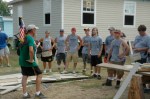
And when he played the last note, Terry  rested his bagpipes under his arm and gave the workers a send-off speech fit for William Wallace:

DSC_0132“You should be proud of your work here,” he told them.  “I know your parents would be very proud of you too.  On behalf of the Habitat for Humanity organization and the people of New Orleans, I want to thank you for your service. You made a difference here.  I want to play another song that is dedicated to each and every one of you.”

And then he played “Amazing Grace” in tribute to a group of kids that would have likely found lots of better things to do this summer than swinging hammers in 98% temperatures and 90% humidity!  

I think when a city floods a lot of stuff gets shifted around and some gets left behind and some gets washed away altogether.  Sometimes the waters bring reconciliation and sometimes they bring the likes of Terry Cooney.

There is healing in this stifling heat. Each nail, each river of sweat, each silent tear shed for one man’s Amazing Grace, each hammer swing– a labor of love.  

In that instant of stillness after the bagpipe drones go silent, we hear the eerie cicada rhythm resume again.  Back at work… they serenade the habitats.  It is as if,  like Terry Cooney, their song is never done.

DSC_0238

Leave a comment

Filed under resiliency, teaching

JOURNALING CHAOS 6: “Rains in Oakland”

chaosjpeg

The “I Ching” teaches that “Before there can be great brilliance… there must be chaos.”

This is PART 6 in a series of blog posts that document our research, strategic thinking, observations and debates as we take on one of the last vestiges of the industrial revolution: the practice in schools of organizing kids into grade levels according to their chronological age.

Maybe it’s me.  Maybe I have “charter envy”.  

Maybe we just haven’t figured out all the things that The American Indian Charter School in Oakland has discovered to drive up their test scores.  With an API of 967, they are one of the very  highest performing public schools in California. Moreover, 88% of their students qualify for free an reduced lunch, so they have somehow managed to overcome poverty.

grailjpegIn fact I wondered if they had found the Holy Grail. I wondered if maybe my ideas about insuring that kids mastered the standards before they moved to the next grade level… might be a little draconian;  maybe even unnecessary.

A donor from the Koret Foundation in the Bay Area was adamant in her praise for The American Indian Charter School:

“They really should be the model for public education in the state of California,” she said.

And she also said: “What I will never understand is why the world is not beating a path to their door to benchmark them, learn from them and replicate what they are doing.”

So short of “beating a path to their door” I decided to at least read the recent LA Times article wherein these quotes were found, along with a general description of just what is happening to engender such astounding results at The American Indian Charter School. The reporter, Mitchell Landsberg, was clearly impressed and even amused by the leadership there. But perhaps surprisingly, he seemed a little conflicted on whether what was happening at The American Indian Charter School– not withstanding an API of 967– was actually good for kids. 

la times

But we steal good ideas so I read on:

I read that the school administrators take “great pride in frequently firing teachers”.  Ok.  But we don’t do that at El Milagro. We choose to not give up on  people whether they are students or adults.  So I’ll leave that plan to Oakland and keep reading.

I read that they hand-pick their students and that as one administrator (and parent of a student in the school) confirmed: “They have kids who could go anywhere in the state and succeed.”  Well that’s good for them.  We have kids like that at El Milagro too.  Except they didn’t start off that way.  We didn’t get to cherry pick them. We worked hard and the kids worked hard and their parents worked hard to achieve a level of proficiency. We don’t choose our students… they choose us!

one roomjpegI read that they have, by design, no lab equipment, no computers, no televisions, no games at PE.  They mock multicultural curricula (“the demagoguery of tolerance”)  and reject efforts to build children’s self esteem.  It shows. The director refers to students of color as “darkies”!

Anyway, the tools of instruction at The American Indian Charter School are textbooks and worksheets. It is teacher talk and drill and kill. Hmmmm. Disappointing.

Then I read how discipline is so strictly enforced.  After school and Saturdays.  They are not above calling kids out, humiliating them, punishing them, forcing them to wear embarrassing signs.  One student had his head shaved in front of the school for stealing!  “Classes are preternaturally quiet and focused” writes Landsberg. “They have been told to keep their attention on their work.  They do as they are told.”

Now I am aghast.  So I checked on the website and it is indeed a school in California and the year is indeed 2009 and The American Indian Charter School is indeed a school lauded by the likes of George Will as a model that could close the achievement gap in America.  And admittedly, they do have that amazing API.

Then I read that attendance is mandatory (as it is at El Milagro, too. To an extent.)  When an African American student took a day off from the rigors of The American Indian Charter School to watch the historic inauguration of President Obama with his family, he was punished with extra work and the principal’s recommendation to a private high school he wanted to attend was rescinded.  His mom was justifiably outraged and removed him from the school.  The principal defended her actions:  watching the inauguration, she argued, “is not part of our curriculum.” Now I am outraged too.

So what is the curriculum?  This reads like a horror story.  Where is the magic that explains 967?

I read that the curriculum is, in essence, the California Standards Test.  The American Indian Charter  School” relentlessly and unapologetically teaches to the test.”  They teach almost nothing that does not directly affect standardized test scores.  

And so, taking all of these strategies together, the best practices of the American Indian Charter School– teach to the test, military style discipline, drill and kill, no computers, humiliate the kids–  their students score well on the CST and it all adds up to an API that we should all aspire to and “replicate.” Is that the story?

Well no thank you. If George Will wants to hold out models of schools for others to replicate he can.  But there is nothing about this story or this school that reflects the kind of excellence I would seek for my own children. Good enough for the “darkies” though, hey Mr. Will?

chess

So now I have lots of questions:

Where is the commitment to children, the passion, the love of teaching and learning?  Where is there room for creativity and innovation. Where is the intellectual integrity? How do children become technologically literate in places like this? How do they learn to write and solve problems?

And is this really the price we have to pay to bleed high API numbers out of communities that are already struggling?  Is the California Standards Test a legitimate measure of school success if somebody can produce these results using such outdated and oppressive instructional approaches?

I like the Bay Area and I like Oakland.   I like the rain there.  And I am sure I would like the kids and the teachers of the American Indian Charter School. But you cannot rise to the heights our children deserve by riding on the wings of Icarus.  This is not the Holy Grail.  So if you don’t mind, we will keep looking.

g2rail

11 Comments

Filed under California charter schools, charter schools, El Milagro, public education, standardized testing, teaching

JOURNALING CHAOS 1: “First Bricks”

chaosjpeg

The “I Ching” teaches that “Before there can be great brilliance… there must be chaos.”

This series of blog posts documents our research, strategic thinking, observations and debates as we take on one of the last vestiges of the industrial revolution: the practice in schools of organizing kids into grade levels according to their chronological age.  

We have been talking about school reform for as long as I can remember.  And restructuring.  Revamping. Creating distinguished schools.  Schools of excellence.  Blue ribbon schools. 90-90-90 schools. Break-the-mold schools. Effective schools. Charter schools. 

title1aaalogo1

But schools– even schools like El Milagro–  are still pretty much the same as when I went to them. And so are the results. We still have an achievement gap that separates our children’s future along the lines of race and class and home language.  We still struggle with the edicts of Sacramento and Washington, DC. We get bombarded with research studies from university professors who are among our  nation’s least effective teachers.  We push our kids and our teachers to the limits of their patience and ability and health.  We squeeze blood from a turnip.  We eek out the last 3 API points and scramble and strain to “meet our AYP goals.”  We adjust to all the latest changes in the state’s nuanced metrics and how we keep score.

And we make progress.  For a price.

This is not what educating our children should be about.  This is not teaching and learning.  It is not preparing children for the competitive rigors of the 21st century, globally interconnected, green and fragile world they are inheriting. And you know it!

And so do I.

the revolutionSo today I am throwing the first brick in the revolution.  Right through the freaking window.  Today it will be one brick.  Tomorrow another.  And then another.  And I’ll invite you to pick up a brick or two as we get the momentum leaning our way.  We are going to change El Milagro. And this blog is going to chronicle the change– the revolution– brick by brick by brick.  

I am aiming at one very traditional, very systemic, very sacrosanct structure that is creating the greatest roadblock to our forward progress.  In the parlance of the extended  war metaphor:  we are taking out a strategic bridge that has kept us constantly circling back to our beginnings.  It was the wrong bridge from the beginning but now it has been there for 150 years and it’s hard to imagine life in our schools without it.  But we’ll all get used to it.  We need a new bridge that will take us in a very new direction.  It will provide a different view of the horizon and the pathway to a very different destination.  

The bridge we are taking out?  The one that leads to the same outcomes every year?  The one that lures us into taking three  steps forward and two steps back as an annual ritual?

It is the extraordinarily resilient model of grouping children by their chronological age. 

That’s the target.  It may not seem like much right now, but if we take out that bridge a revolution in public education will spread and from the ensuing chaos… there will be the potential for great brilliance. 

Follow this blog series and you will see why.

3 Comments

Filed under California charter schools, charter schools, El Milagro, standardized testing, teaching, Un-graded schools