CELEBRATE… THE SEA BREEZE, THE 840

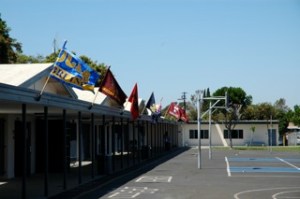
stillIt is Day 3 of the 2009 California Standards Test and it is quiet across the campus.  Still.  Ghost-like.  Except for the traffic up on I-5  whistling like a turbine and leaning ceaselessly into the North wind.  The South.

Our kids have prepared— not PREPPED– but prepared, all year.  They studied the right stuff and learned the right skills and held the same data up to the magic moonlight like the rest of us did.  So they are ready.

It is a precise science now– the advancement of a school toward the testing regime.  There are balloons signaling “840”– our school-wide goal. As if anyone could forget that that is our school-wide goal.  It is, after all,  painted in fresh colors on our psyches.  We set the goal ourselves and based it on some somewhat arbitrary variables like (1.) we have grown 40 points in one year before and (2.) the school down the street is at 840 and (3.) we are just 40 points better at teaching than we were at this time last year so (4.) what the hell!  840.  

danceeeeNow we are in it.  And that heads-down, pencil-gnawing silence of testing is mixed in with a healthy dose of celebration.  Every day.  Today the staff will play the 7th and 8th graders in flag football.  Yesterday there was a school-wide movie, a huge game of  “Capture the Flag” and a chess tournament.  The day before we cranked the music up and danced on the black top.  Testing time is also a celebration of learning.  We equate it with the team that practices all week long for a big game on Saturday.  The practice is fun… but it doesn’t compare to the rush of competing in bright uniforms against another team.

Test days are game days!

Still, the nature of the whole testing thing worries me.  There are at least these 10 things I hate about the test in California:

• It is a test of basic skills in language arts and math but we don’t test in the primary language of our students. So now it is not only a test of basic skills, it is a test of language acquisition.  Our English Language Learners (ELL’s), on top of the other mountains they have to climb, are not really given a chance to show what they know.

• While the mobility rates of students is controlled for (students who transfer in after October don’t count toward the “840”)… they still count.  Including the 4 that transferred in from other schools last week.  

• We will have to wait for 3 months for the results.  If we are leveraging the future of the nation on these results… why can’t we find the technology to score these things and get them back next week?  We need the data.  

• I have read California’ “Released Test Items”.  I know what is on the CST’s.  It covers some standards.  But it misses plenty.  Our kids are gifted in many ways and not all of those intelligences are tested.  Most aren’t.  They will get no credit for their musical or athletic talents.  Their ability to speak two languages, a gift so many adults covet, will neither be assessed nor mentioned.

• Our 8th graders will be gnawing on their #2 pencils for 90 minutes a day, for  8 straight days.  They will test in language arts, social studies, science and algebra.  It is too much testing.

• I hate the bubbles.  But I guess it is fun for kids.

• I hate that grade level Proficiency is harder to demonstrate in California than the rest of the country.  The test is just harder.  Other states are sand-bagging their kids so they have less “Program Improvement” schools.  And they know it.

• I hate that there is no room for creativity.  Daniel told me that the test is too easy and that the “questions suck”.  He will get the maximum scaled score of 600, again, and for him the questions will suck.

• I hate that the California Standards Test is standardized, even if teaching and learning and children are not.

• I hate that we get only one shot at this. 

bubbles


But enough whining.  There are at least as many things I like about the California Standards Test:

• The data will allow us to continue to improve and leverage significant, revoultionary change as a charter school.

• We will know that our students are learning and that they are learning what they are supposed to be learning.

• The content standards, the “rules of the game”, are now crystal clear.  They are out there.  

• Parents an students know what those rules are.  They know what they have to master in order to be considered “Proficient”.

• Being “Proficient” matters to our students.  To every one of them.  It creates a clear, unambiguous goals for them to achieve and a pathway to work from.

• Our students are always going to fill in bubbles on standardized, multiple choice tests. They will fill in bubbles in AP geography mid-terms, on the PSAT and SAT and GRE, on the driver’s license exam and on the state Bar exam.  Our students are learning great strategies (and developing healthy attitudes) about all of these.  They are getting good at filling in bubbles.

• The CST is a school-wide culmination of learning.  It is an EVENT.  It is a celebration! We build towards it all year.

• The CST data is summative.  It doesn’t help us make in-flight adjustments.  So it inspired us to find our own assessment system; our own formative tests that help us monitor our students’ academic growth all year long. In real time.

• The CST gives every teacher, employee, student and parent a common mission; a target. 

• The CST is data.  You grow or you die.  No excuses.

feetball

As I was writing these last few bullets… I noticed a few students going down to the rest rooms.  They have been at it for nearly two hours and they are starting to emerge from the caves.  Exhausted. But there is still a sparkle in their eyes.

“Morning guys.  How did your testing go?”

“It was easy!” they answer in unison.  Like they practiced it.  Or expected it.

When they say it was “easy” it could be a good thing or a bad thing.  We don’t know.  We won’t know for three freakin’ months.  In the meantime, we will celebrate teaching and learning and get ready for Day 4 of testing tomorrow.  And we will try to preserve our undefeated record in flag football against a very test-weary but game group of 7th and 8th graders. And we’ll pump one more day’s worth of helium in the balloons. 

Meanwhile, the sea breeze blows across the playground and the balloons bow.  840.

840

1 Comment

Filed under charter schools, El Milagro, public education, standardized testing, teaching

100 THINGS I AM OPTIMISTIC ABOUT ON THE 101st DAY OF THE OBAMA PRESIDENCY

*Apr 28 - 00:05*

…Education, Iraq, swine flu, press conferences, basketball, being American, economic recovery, green energy, housing, kids, race relations, jurisprudence, Pakistan, college costs, the White House website, Republican demise, GM, Oval Office photos, American voters, health care, health care for kids, Guantanamo, choice, Hispanic caucus, charter schools, Twitter, Michelle, the cabinet, Ted Kennedy, NY Times, NY Yankees, Bo, Peace Corps;

JFK, Teach for America, Hugo Chavez, Washington DC, the Obama kids, on-line media, high speed rail, Isreal, stock market, Arlen Specter, waterboarding,  MSNBC, US troops coming home, Fair Pay Act, a new NCLB, affordable student loans, Air Force 1, families, world travel, stem cell research, change, civil rights, the US Constitution,  gun control, global warming, New Orleans, honest communication, US reputation abroad, GNP, the VP;

Jazz, Rachel Maddow, early childhood education, NASA, environmental protection, fuel economy, Earth Day, veterans, immigration, S-CHIP,  Americans with Disabilities,  G-20 Summit, jobs,  home ownership,  fairness, nutrition, 21st Century skills, work-family balance, performance, Social Security, foreign policy, Nuclear waste disposal, Islam; 

Darfur, fossil fuels, US tax code, executive orders, National Academy of Sciences, clean energy, urban America, fitness, organic gardens, homeland security, the arts, poverty, dynamic speeches;

Two terms.

gal_barack_02

Leave a comment

Filed under charter schools, El Milagro, environmental studies, health care, President Obama, public education

WHAT’S MISSING IN THE PRESIDENT’S VISION OF SCHOOL REFORM

At this defining moment in our history, America faces few more urgent challenges than preparing our children to compete in a global economy. The decisions our leaders make about education in the coming years will shape our future for generations to come. Obama and Biden are committed to meeting this challenge with the leadership and judgment that has been sorely lacking for the last eight years. Their vision for a 21st century education begins with demanding more reform and accountability, coupled with the resources needed to carry out that reform; asking parents to take responsibility for their children’s success; and recruiting, retaining, and rewarding an army of new teachers to fill new successful schools that prepare our children for success in college and the workforce. The Obama-Biden plan will restore the promise of America’s public education, and ensure that American children again lead the world in achievement, creativity and success.

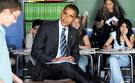
President Obama’s education initiatives are broad-sweeping and on the mark.  Yesterday he presented his plan to make college more affordable and student loans more available to students who really need them.

in-schoolsBack on March 10, he described his “5 Pillars of Education Reform”.  His speech on education highlighted his k-12 agenda, where he intends to

  • Reform No Child Left Behind
  • Support High-Quality Schools and Close Low-Performing Charter Schools
  • Make Math and Science Education a National Priority
  • Address the Dropout Crisis:
  • Expand High-Quality Afterschool Opportunitie
  • Support College Outreach Programs
  • Support College Credit Initiatives
  • Support English Language Learners
  • Recruit Teachers
  • Prepare Teachers
  • Retain Teachers
  • Reward Teachers

If we go there– if we improve educational access and opportunity at the pre-school level as well as the K-12 and post-secondary levels, he can leverage the reform he is looking for.  At least in some small degree.   The problem is, for all the detail and ambition, the Obama education vision still does not reach far enough.  His education plan is still missing one critical component– without which–  the success of all these other reforms will be compromised.  Partly because this list of initiatives has already been implemented. There are examples and best practices of these approaches all over the country, and yet, the academic achievement gap persists.

So what is that one, profoundly  revolutionary change that will finally transform public education in America?

roceli1Universal health care.   

Just as his plan to revive the economy hinges on health care, so too does any significant hopes of educational reform.  

It’s the health care.  And the reason is quite simple: 

American schoolchildren should not have to suffer through illness or medical trauma while our health care system shuts their family out from the treatment they require and deserve.

They should not have to come to school with teeth rotting in their heads for lack of dental care.

They should not fall behind in reading (never to catch up), simply because they have undiagnosed vision problems that are often easily corrected with glasses.

They should not suffer in silence, as a first grade child at El Milagro did two year ago, while we negotiated for hearing aids with Childrens Hospital.

They should not have to endure the physical discomfort nor the  social alienation associated with childhood obesity.

They should not have to manage the debilitating side effects of poor nutrition or childhood hunger.

They should not be denied access to mental health treatment, or counseling, or therapists or specialists available to other students whose parents have complete health coverage.

Learning is hard enough to do for students, especially in a climate of ever-tightening accountability.  But where there are inequities in academic outcomes, we almost inevitably find families in economic distress.  While parents struggle to maintain their homes, keep their jobs, make a living, make a life…  they should at least have the confidence that the health care needs of their children are provided for.

If President Obama can deliver on the promise of universal health care for our children, and if public schools fully harness the power of that reform, we will see a significant reduction in the academic achievement gap that has perpetuated the inequities across socio-economic levels for decades.  

The Obama doctrine on education states:

At this defining moment in our history, America faces few more urgent challenges than preparing our children to compete in a global economy.

“Preparing our children academically to compete in a global economy”, hinges on their ability to come to a safe school, to focus, to work hard, to believe in their own capacity as citizen-learners.  It hinges on their physical, emotional and mental health.  In fact, if he can provide all of our students with HEALTH CARE, President Obama will prove to be the most influential leader in public education in our lifetimes.

prez-1

3 Comments

Filed under charter schools, El Milagro, health care, President Obama, public education, resiliency

HIGH STAKES… All IN

testsWe are two weeks from the 2009 iteration of the California Standards Test.  The clock is ticking. We are prepared.  We are in a zone.  And we better be…considering the high stakes.

High stakes?  Isn’t that just residual hyperbole left over from the NCLB-era politics?  Well let’s check it out.  

Here are a dozen ways that standardized testing has resulted  in high “stakes” outcomes and their unintended consequences:

• High stakes because the results are going to follow every student for the remainder of their school careers.

• High stakes because schools will use the results to determine students’ eligibility for after-school programs and tutoring opportunities and Advanced Placement classes and extracurricular activities. Even for eligibility (and thus in-eligibility) for participation in athletics and the performing arts.

• High stakes because school officials will use the scores as a criteria for classifying children as gifted– public education’s most coveted label.  Similarly, they will cite these scores when diagnosing children as learning disabled.

• High stakes because schools will (illegally) weigh the portents of  these scores before admitting new students.  Or they will consult them– the final straw– before expelling or disenrolling kids; before recommending ‘delinquents’  to a continuation program or independent study or homeschooling or some other version of learning in Siberia.

In high stakes testing, the results matter to everybody. 

board-mtg1

• They are “high stakes” because presidents and governors and mayors run for elected office on the promise of improving local trends in standardized test scores.  School board members too.  And the superintendents that school boards hire will survive on their ability to deliver higher scores on metrics like the Academic Performance Index (API).  Likewise the principals that the superintendents hire will come and go like bad wind and pretty much everybody will feel the pressure when the next wave of leaders are clearing out their desks and insuring their colleagues that they have always wanted to return to the classroom.  

• High stakes because that pressure to raise test scores will drive teachers with the most seniority (and experience) toward the schools with the higher API (800+) and lower stress levels. 

u-haul-1• High stakes because schools with low API’s (<700) will continue to replace those migrating veteran teachers with brand new inexperienced teachers who will take five years to learn their craft… and then they will migrate too.  And while they are learning, those younger teachers will be just starting to raise families of their own.  So you can expect those teachers to be out two to three months on maternity leave and to be temporarily replaced by long-term substitute teachers who have less training and less experience than the inexperienced young teacher they are replacing.

And the community will witness the invisible forces of the high stakes tests in ways they could never imagine.

• High stakes because when educated, upwardly mobile young couples start looking for a suitable neighborhood in which to raise their families they inevitably consider the quality of the schools.   They consult websites like greatschools.net and identify the school districts with the highest test scores.  And that is where they buy their home.  

poway11


• High stakes because when large groups of young, upwardly mobile couples get together to raise their children, they insist on state of the art pre-schools and they start volunteering in the elementary school before their kids are old enough to walk. So a whole community evolves around a culture of high achievement. It becomes pre-ordained and the Academic Performance Index of the schools go even higher.

• High stakes because the schools with low API’s struggle for any organizational momentum at all. They tend to serve families who are less educated and thus less upwardly mobile.  They tend to serve families that are in survival mode. They do not tend to attract the new young families who just moved to town and who are looking for the very best schools.  

• High stakes because the communities with large clusters of well educated and upwardly mobile families experience far fewer home foreclosures than those where families took greater risks with loans.  (In San Diego County, for example, the top five zip codes with the highest number of home foreclosures featured schools with an average API of only 754.) Home foreclosures lead to higher student mobility rates as families migrate toward more affordable housing options.  

High stakes.  

high-stakes2• High stakes because we are all compelled to strike hard against the mountainous challenge of quantifying children’s learning on the basis of  a single standardized test.  We will balance the winners and the losers and the inevitable damage caused when the best of intentions collide with unintentional consequences.  And that is, by definition, high stakes– where our systems align poorly or not at all. And  for that incongruence…our children pay.


In California, there are only two weeks remaining until we administer  the next version of the CST. When it is complete, we will dutifully send our thousand student answer sheets off to Sacramento with a blind faith that they will be accurately scored.  And the cycle of waiting for the results and the early analyses will begin anew.  

Our students are ready to play the game. It is high stakes. We are “all in”.

2 Comments

Filed under California charter schools, charter schools, El Milagro, gifted children, public education, standardized testing

MUSICIAN’S VILLAGE

dsc_0070

Spring Break just ended and I have now gone the longest I have ever gone between posts.  It is bad practice, no doubt,  to miss my weekly publishing day (which is normally Saturday!).  But I have a good excuse.

dsc_04111Anne and I have just returned from New Orleans where we volunteered for service with Habitat for Humanity and helped build homes in Musician’s Village. That is, we helped in the way that volunteers help when they have limited experience with actually building, using power tools, climbing ladders or hanging from roofs. But we helped. 

And as always, the ambiance of New Orleans was amazing.  

But so is the heartache. And so are the wonderings.

And so I wondered, 4 years after Katrina, why there are still hundreds (thousands?) of homes with holes in the roofs and boarded up windows and debris piled in the yard.

dsc_0376_2I wondered why so many  of those uninhabited houses still bore the crimson “X’s” spray-painted by search and rescue teams and framing the cryptic code for the number of  victims still inside.  And I wondered how those search tattoos worked on the psyche of children and adults alike.

I wondered why in some neighborhoods, all of the properties are restored, while in the poorer, more segregated neighborhoods, entire block are still abandoned. (Actually, I didn’t really “wonder “why this is happening at all.  These are the same people that were abandoned from the day the hurricane hit. They were left on bridges and rooftops and dumped into sports arenas.  And they still aren’t getting much help.)

So I wondered if the guy they keep trotting out as “the next Republican contender for president, the governor of Louisiana, has been in the Lower Ninth Ward lately.  I wondered how you can approach the problems and challenges of the presidency if you can’t tend to the needs of your own community.

I wonder how many people moved back into homes that they shouldn’t have moved back into.  Homes where the walls are filled with mold and the cockroaches prop up rotting foundations on their backs.

I wondered why so many schools still aren’t operational yet and how much longer it is going to take.

But then again, I wonder what we can all learn from a resilient city that has bet the majority of its waterlogged educational system  on the promise of charter schools .

I wondered, with the return of so many musicians to New Orleans, could the city’s full revival be far behind?

dsc_0249

dsc_02661dsc_0305


And I wondered how the children are since Jazz Became Hope.

dsc_0256

2 Comments

Filed under charter schools, El Milagro, resiliency, spiritual intelligence, Uncategorized

GETTY’S STEPS

students_youthtriumphant

Our students were exhausted on Wednesday night but they had enough left in the tank to finish their reflections in their college tour journals:


• “I know now that it is possible for me to go to college.  They have something called grants and loans.  There are no excuses…”

• “The students we met at USC were inspiring.  Especially since one of them went to high school in Chula Vista!”

• “No one in my family has ever visited a university before.  Or gone to one.  I will be the first.”

• “At first I didn’t know why we were going to the Museum of Tolerance during our LA College Week.  What does the holocaust have to do with going to college?  We have been reading about the holocaust but it is deeper than that and I am still thinking about what we learned there. Maybe there is no right answer but I am beginning to see a connection.

• “When I get home I am going to check my class schedule for next year.  I could have taken some more challenging classes but I told the counselor I wanted to just take basic stuff.  But now, I don’t think basic stuff will get me to USC.”

• “When I first saw the championship banners hanging from the rafters in the Pauley Pavilion I just stood there and cried.  I have dreamed about this.  I know I can go to school here some day.”

And so on.

group-32

Our 8th graders may be only 13 and 14 but they get why we load them on buses and take them to LA for three days in April.  This is our second year in what will become our annual LA College Week.  It is an extraordinary journey through some of Southern California’s most prestigious universities:  USC, mono-cardinal-white-bigUCLA, Pepperdine, Cal State Long Beach, UC Irvine.  Our students already visited San Diego State and the University of San Diego and UCSD when they were in 7th grade.  As juniors at Chula Vista High School they will vist UC Santa Barbara, Stanford and UC Berkeley.  By the time they are seniors, they will have been on the campuses and met the students of 15 to 20 colleges and universities. They will have been to the bookstores and worn the t-shirts and filed their photographs and memories. And of course, they will have demystified the college experience.
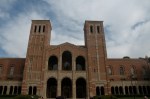
Ryan and Marisol designed a three-day itinerary that kept them moving and introduced some very interesting features of LA life:  Universal City Walk, the Santa Monica Pier, the Getty Museum and the Museum of Tolerance.  It is a lot to pack into three days.  And it all connects.  And it all reaches them at one level or another.

And now they know that if they can go into 9th grade with a strong wind at their back. They can compete in AP courses.  They can involve themselves in community service and leadership roles.  They can play sports or march in the band or join a dance team in the School for the Creative and Performing Arts.  They can surround themselves with positive people who have the same goals and aspirations.  They can rise above the inevitable challenges and difficult circumstances that will no doubt try to push them back from the edge of their dreams.

uclabldg1But in their experience here, in their exhaustion and deep reflection– some of which may even have been written down– 60 more American 8th graders will understand that we determine our own destiny.  There are no limitations, no excuses, no barriers.  They are as likely to be enrolled at UCLA in five years as any other scenario that they might themselves imagine.  

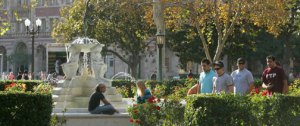
Late on Wednesday afternoon, while our students were still processing the awful lessons of the Museum of Tolerance, we drove to the Getty Museum and breathed the different air.  There was light there.  Our students looked at each other in the eyes.  Their playful spirit returned.  

“I liked the gardens of the Getty Museum. And the stairs and all the fountains.  And I liked the view of LA.  I could see UCLA from the back balcony.  I could see myself there in the future.”

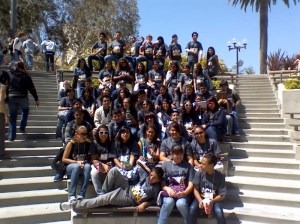
We asked our students to find a spot on the sprawling stairs leading up to the main museum and to adopt a distinctive pose.  We took a a group picture. There are no names in the caption.  The figures are too small to identify.  But together, there is a synergy that we hope will last.  They laughed as they scrambled for their own place to stand and fumbled through several awkward iterations of their final pose.  Some never quite found it.  Others became impromptu models.  And even 8th graders, having the time of their lives, discovered right there on Getty’s steps that life can indeed imitate art.

dsc_0227

Leave a comment

Filed under Uncategorized

AT GUNPOWDER POINT, NEW FIRE

marshGunpowder Point is bathed in ocean breeze and bird poop.  It is now a protected marshland in what seems to be the last square foot of undeveloped land in Chula Vista.  Bordered by freeway noise to the east, and insulated by acres of natural foliage, the Nature Center leans into that stealthy wind.
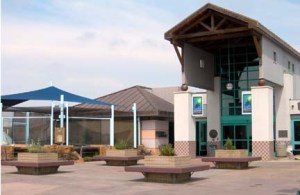
turtle_lagoon_frontAnd all of this matters.  The Nature Center is less than two miles from El Milagro and is perhaps a missing piece to the persistent dream we have had of utilizing the natural resources of San Diego Bay as a daily classroom.  It is one thing to go on a field trip … it is another thing to attend school in the slough, to walk among the endangered Clapper Rails, and observe the hypnotic swimming patterns of sand sharks. Every day. As a part of the curriculum. 

forclusre1The Chula Vista Nature Center is facing tough times in the struggling economy.  Chula Vista itself was once listed among the fastest growing cities in America.  Today, whole rows of streets and neighborhoods prop “For Sale” signs on foreclosed lawns, where the dreams of families were packed so hastily  and moved, months ago, to higher ground.  The city is in trouble.  And they fund the Nature Center.  So we want to help.  

After years of diligent budget management under  the watchful eye of  Mr. Wizard, Mueller Charter School is well positioned to weather the otherwise unforgiving fury of a distressed state budget.  So we want to lease a classroom space from the Nature Center.  We want to move our middle school science classroom there and weave them into the daily rotation.  Instead of going to science in room 902, their classroom would now be located on Gunpowder Point.  We can provide the City of Chula Vista a badly needed new funding stream to save the Nature Center; they can provide us a chance to model learning in the real world– the charter vision come to full fruition.  

This is an area rich in history.  It was once home to the Kumeyaay Indians and Spanish settlers.  It still bears the ruins of the old Hercules building where kelp was harvested for gunpowder and potash in World War I.  It was a lemon grove and movie set.  It was the scene of horrific fire that destroyed it all.  And beneath the protected marsh and slough, you just know, generations of human settlement have collected layer upon layer of artifacts.

baldeagleheadImagine children rotating through varied learning opportunities over the course of a school day: contributing to data collection and exhibit management, developing individual research projects that make a significant contribution to the body of knowledge accumulated here, serving as museum docents and guides at the sting ray petting area, performing community service to help maintain the sprawling acres, advocating for green energy.  Imagine children not just simulating the work of science, but being scientists. Contributing.  Developing not just an appreciation for the fragile interdependence of  living ecosystems, but a profound reverence for their own place in the world.  Here there are owls and sharks, reptile and eel aquariums, there are marshland aviaries, and shoreline birds.  There are rare sea turtles.  There is an adult bald eagle.  

Every day, every student would pursue answers to one urgent question that scientists all over the planet are researching.  Something like this:   “How do human developments along our natural waterfronts contribute to and compromise the fragile ecosystems that exist there?”  Our 7th and 8th graders would explore, investigate, experiment, and publish their findings through wikis and blogs in collaboration with children from around the world.  

This is real science.  Authentic learning.  John Knox says you have to teach and learn science with all five senses– and for all you’re worth.  You have to be outside.  In the middle of it.  You have to get your feet muddy and splash aquarium waste water on your shoes.  Appreciate the stench of the owl barn. The sting of the cactus needle.  The rotting kelp.

We are poised for an extraordinary partnership and, for our students, the learning experience of a lifetime.  Here on Gunpowder Point, where early Chula Vistans fought the world war from the banks of San Diego Bay, there is an opportunity to give meaning to the daily joy of learning.  Here in the marsh and the wetlands– new fire.

cape_cod_beach_fire

5 Comments

Filed under California charter schools, charter schools, El Milagro, environmental studies, teaching

A LONG KICK AGAINST THE WIND

filmstrip06ew

Yesterday was my day to post on Leadertalk, which is one of several blogs managed by Education Week. Educational leaders are invited to participate– and my day is the 20th of every month.  So I am always thinking about what I want to post on Leadertalk.  It is harder to add photos and I feel a little more confined, like I have to be much more careful since it is someone else’s deal.  Nevertheless, as a neophyte blogger, it is a cool opportunity.

So I decided to post a hybrid piece, combining the elements of what I published here at El Milagro Weblog last week and my idea for today. 

Because as of today we are 5 instructional weeks from the California Standards Test (the CST’s!)  and our teachers are studying their formative data and making some very strategic adjustments in how they work with their students on the final push.  5 weeks is the blink of an eye and they know it.   We are still a long ways away from where we need to be.  In fact, our MAPS data tells us that 22% of our English language learners are now operating at a proficient level in language arts and 23% in math.  We need at least 50% proficiency to reach the state’s Annual Yearly Progress (AYP) goal.  

This is crunch time.  Our teachers are as serious and as focussed as I have ever seen them.  There is no panic.  There is no quit.  There are no false illusions about where we are.  So it will be interesting to see how our students perform on California’s standardized tests in May.  

field-goal1This is also the time period in which we cease to philosophize about the wisdom of standardized tests and what the pre-occupation with language arts and math might be doing to our students’ broader abilities to think and innovate and solve problems and reason.  This is not the time to engage in the political debate.   An NFL coach may not like the rules for sudden death overtime, but when you are out of downs on your opponents’ 20-yard line, you better just trot out your kicker for the game winning field goal and argue about the rules of the game later.

ny-timesjpeg2So we are playing to win.  And when we win, we expect that there will be some interesting headlines in the morning newspaper.  Something like:
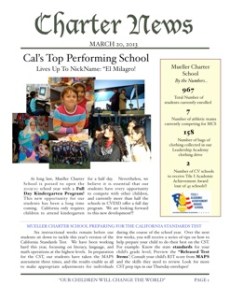


“California Charter School Shocks Education World”

or

“Mueller Charter School Achieves Unprecedented One-Year Gains”

or

“State Department Questions Legitimacy of Dramatic Test Results


It is a healthy exercise  to visualize your organization’s success and there are many ways to do it.  But try visualizing the newspaper headline that captures the essence of your  mission and celebrates the moment at which all your collective dreams and ambitions come to full fruition.  What will the headlines say? 

“Charter School Caps Decade of Innovation by Tipping 901 on API”

hands-up

As a visualization exercise, this headline is dramatic.  But it is more than an exercise… it is our mission.  And it is attainable.  We have implemented a longer day, a daily English language development program in every classroom, our assessment tools have improved and so has our capacity to use technology.  And those are just the highlights. So now all that is left is five weeks of instruction, a 45-yard field goal (against the wind)  and the long vigil at the news stand.  Just what will your headlines say? Perhaps ours will read:

“California’s Top-Performing

School Lives up to Its Nickname:

El Milagro!”

headlinez

Leave a comment

Filed under California charter schools, El Milagro, public education, teaching, technology in schools

5 PILLARS TO SAVE A NATION

education_hero

“Every so often, throughout our history, a generation of Americans bears the responsibility of seeing this country through difficult times and protecting the dream of its founding for posterity. This is a responsibility that has fallen to our generation. Meeting it will require steering our nation’s economy through a crisis unlike any we have seen in our time.”

This past Tuesday  morning, President Obama presented his proposed education reforms to the Hispanic Chamber of Commerce in Washington DC.  If the Hispanic Chamber of Commerce is going to advocate at all for Latinos and their children in the United States, they should take great confidence away from that bright, bright morning at the Marriot Ballroom.  In the background of the President’s message  is an economy that has been ground down to the core by too many individuals who were entrusted to leave the machinery of commerce better than how they found it.  But once they got their hands on the wheel, the temptation to achieve personal gain, the lack of compassion, the lack of regulation, the lack of restraint, the lack of moral guidance, the lack of patriotism–  led the country and the rest of the world– right over the cliff toward economic collapse.

stock-mrktjpegThis happened on the last President’s watch, the one that talked about patriotism and Christian values and keeping America safe.  The one that imposed No Child Left Behind on America’ s schools and accelerated an era in which the illusion of accountability and achievement has merely driven schools to gun the motor, spin the tires in the mud, and lurch forward in the wrong direction in a cloud of spent energy and system-wide exhaustion. Just like the economy.  President Obama said:

“Despite resources that are unmatched anywhere in the world, we’ve let our grades slip, our schools crumble, our teacher quality fall short, and other nations outpace us. Let me give you a few statistics. In 8th grade math, we’ve fallen to 9th place. Singapore’s middle-schoolers outperform ours three to one. Just a third of our 13- and 14-year-olds can read as well as they should. And year after year, a stubborn gap persists between how well white students are doing compared to their African American and Latino classmates. The relative decline of American education is untenable for our economy, it’s unsustainable for our democracy, it’s unacceptable for our children — and we can’t afford to let it continue.” 

So President Obama  connected the dots on the moribund economy and our bankrupt schools and the illusion of academic progress for a nation leaving virtually all of our children behind.  The two systems are inextricably bound.  

While there may have been too few voices signaling our economic demise with any authority or passion, we have been signaling the alarm from within our schools for 8 years:  educating children, particularly those who are severely impacted by our nation’s recession, requires a lot more than threats and bullying over standardized test results. But just as opposition to the war in Iraq was regarded as unpatriotic, warning of the dangers of such a myopic view of teaching children was disregarded as “excuses by educators who are afraid of being held accountable.”

We merely linked the academic future of our children to the economy and to the federal government’s responsibility to help ameliorate  those punishing risk factors that inhibit children’s learning.  And we were right.  In fact, two important studies were released this week that neatly framed President Obama’s vision for public education.  The first was a joint study from the Education and Public Interest Center at the University of Colorado at Boulder and ASU’s Education Policy Research Unit.  That report described seven “out-of-school factors” that profoundly influence students’ academic success and lead to inequalities among children: prenatal care; health care; food insecurity; environmental pollutants; family stress; neighborhood characteristics; and lack of extended learning opportunities, such as preschool or summer programs.  The report’s conclusion is that schools cannot address these variables alone.

And we’ve been saying that too.

20090323_107The second study came from the National Center on Family Homelessness who now estimate that one in every 50 American children is homeless. In summarizing the report  Time Magazine’s stated, “The consequences of homelessness are profound. Homeless children are twice as likely as other children to be retained, or held back, one academic year, or to be suspended or, ultimately, to drop out of school altogether. School districts across the country report a growing share of students who are highly mobile — who move multiple times within a school year. With each move, experts say, such students are at risk of falling some six months behind, or more, in their studies.” And as a result of our economic downturn, the trend of homeless children is growing.
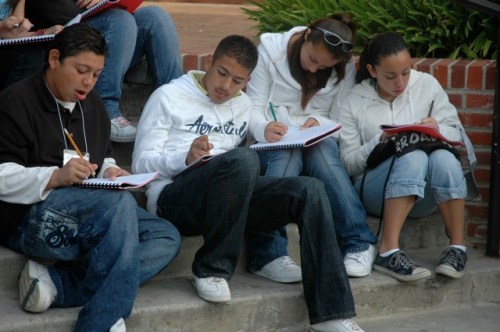
Under the leadership of Secretary of Education Arne Duncan and President Barack Obama, we have an opportunity to reverse the downward spiraling course of public education as we simultaneously address childhood risk factors associated with our volatile economy.  And in fact, Mueller Charter School has been on that path for years– not because of any inspiration from NCLB, but rather, in spite of it!  From the energy and innovation and subversive entrepreneurialism that comes from being an independent charter we have created a school environment that models– at least in part– the President’s Five Pillars of Education Reform as he presented them on Tuesday: 

First Pillar:  Investing in early childhood initiatives like Head Start;  
 
Second Pillar: Encouraging better standards and assessments by focusing on testing itineraries that better fit our kids and the world they live in;         
“We will end what has become a race to the bottom in our schools and instead spur a race to the top by encouraging better standards and assessments.  That’s why I’m calling on states that are setting their standards far below where they ought to be to stop low-balling expectations for our kids. The solution to low test scores is not lowering standards — it’s tougher, clearer standards.  And I’m calling on our nation’s governors and state education chiefs to develop standards and assessments that don’t simply measure whether students can fill in a bubble on a test, but whether they possess 21st century skills like problem-solving and critical thinking and entrepreneurship and creativity.” 
Third Pillar:  Recruiting, preparing, and rewarding outstanding teachers; treating them like professionals and holding them accountable;
 
Fourth Pillar: Promoting innovation and excellence in America’s schools… supporting charter schools… reforming the school calendar and the structure of the school day;

“Now, even as we foster innovation in where our children are learning, let’s also foster innovation in when our children are learning. We can no longer afford an academic calendar designed for when America was a nation of farmers who needed their children at home plowing the land at the end of each day.  That’s why I’m calling for us not only to expand effective after-school programs, but to rethink the school day to incorporate more time -– whether during the summer or through expanded-day programs for children who need it. “

Fifth Pillar Providing every American with a quality higher education–whether it’s college or technical training.


The ground shifted beneath our feet this week, as the President’s message signaled a change in course that favored children.  At nearly the exact same moment, 62 seventh graders from El Milagro were climbing the steps to a university that they had never laid their eyes on before. Our students visited San Diego State University, University of San Diego, University of California at San Diego, Cal State San Marcos and the Arts Institute.  In two weeks, our 8th graders will spend three days in Los Angeles visiting USC, UCLA, Cal State Long Beach and UC Irvine. They will see themselves in the faces of students on those campuses and their life course will be fundamentally altered: from their choice of friends to the goals they set and the courses they take in high school. They will likely be the first in their families to attend college. Their pathway will be made more clear as President Obama’s vision of education comes to fruition, and the unforgiving decline of America’s economy is halted.  

“We have a legacy of excellence, and an unwavering belief that our children should climb higher than we did,” the President said. 

In the meantime, we rise to the greatest challenge of our generation, to right the course of our economy and our public schools, and literally save our nation.

steps

1 Comment

Filed under California charter schools, charter schools, El Milagro, President Obama, public education

50 QUESTIONS

“We are looking at schools that are producing genius… collaborative, gregarious, brave children who care about stuff  like their culture. Around the world people are testing out the ingredients of what makes that work and those ingredients are being assembled into some stunning recipes in different places.  It is a very exciting time for learning. It is the death of education but the dawn of learning and that makes me very happy.”

Stephen Heppell, CEO Heppell.Net, Ltd., UK from the video:  “Learning to Change– Changing to Learn”

2cIn 1985  I bought my first personal computer– an Apple IIc with the chicklet keybpoard and alien screen.  It seemed almost portable enough to carry around like a briefcase.  Or maybe like a computer that could sit right on your lap.  Compared to those old green Kaypros and clunky Apple IIe’s, it was revolutionary. I had a milk crate in my living room and that’s where I put the screen.  I wrote my entire dissertation on my Apple IIc and stored every chapter on a box of labeled discs.

I envisioned a whole classroom lined with Apple IIc’s.  I taught writing and the whole “word processing” phenomenon appeared– in the mid-1980’s– as if it was going to stay.  In fact, when the old grey-haired English teachers bitched in the faculty lounge about “word processing” and how it would never replace the pencil and paper and that it would only make children intellectually lazy because it insulated them from the rigors of real writing (which, to my knowledge, none of them had ever successfully  done)– I refused to join the debate.  I just went back to my classroom, wrote more grants (on my Apple IIc) and lined the walls with the computers that seemed to engage children in writing in a way that few other strategies could.  

mac-floppiesThen a teaching colleague named David Mika pulled up to Muirlands Junior High School with his new Macintosh thing.  You could actually manipulate the cursor right on the screen and “Oregon Trail” evolved accordingly.  And the discs were smaller and made of hard plastic.   They just fit in your pockets better.  They didn’t fly as well as the old floppy discs though.  (I could flip the old discs halfway across the playground.  Digital frisbees. They could put your eye out.  But soon enough they were replaced by CDs which sailed three times as far as the floppies so I startted to feel better about where the technology was headed.)  And so I upgraded my classroom with first generation Macintoshes while still making the best of the now-antiquated IIcs.

Then we could MacDraw and add art work and graphics on color screens.  Then there were internal operating systems.  Then they added audio.  And the high-techpersonal computer wars between IBM and HP and Compaq and Apple and others resulted in business disasters and technological wonders.  Marketing pitches tapped into a nation’s fears about losing our humanity.  IBM’s signature advertising campaign featured Charlie Chaplin in black and white, approaching the PC on a table adorned with a vibrant red rose.  “High TECH”, said John Naisbett, “demands high TOUCH.” And thus, the rose.

Soon enough computers were creating more computers.  The technology was showing up everywhere– from our watches to our automobiles.  And then the internet was born.  And then DVD’s and scanners and document cameras. Then IPods and IPhones and Kindles and Wordles and Wikis and Facebook  and Flip cameras and Wii and Prometheon Boards and Blogs and we know we are only scratching the surface of innovation that our economy and environment will inevitably demand.  Progress is insatiable.  That’s why it is called progress.

And that’s the history of computers in schools.  25 years in a nutshell–  from the Apple IIe to MacBook Pros on every desk and I wonder:  Why are we still not seeing a technology-driven transformation in teaching and learning?  And lots of other people are wondering that too.  In fact we have never seen a complete technology-driven transformation in our schools.  There always seem to be a few tech-savvy teachers on each staff– like David Mika. Eventually they end up in High Tech Charters or become district technology coordinators who advocate for the infusion of computers into every classroom.  They go to tech conferences and write Technology Plans and sometimes they get so comfortable in their knowledge and their favorite strategies that the tech wave crashes over top of them just like it crashes over everyone else and they don’t even know what hit them. 

The knack for integrating technology and effective pedagogy,  it seems, has to come from within.

armando

So on Friday we had our weekly 15 minute staff meeting at Mueller Charter School.  The teachers were asked to watch the video “Learning to Change-Changing to Learn” on You Tube and to write a compelling question inspired by the video that no one else is likely to ask.  Create the $64-million question and bring it to the meeting. And so they did.  And in the space a of a very short time frame, 50 questions were generated that encapsulated all the fears and cynicism and pragmatic reticence and wide-eyed possibility that technology brings to the tough work of teaching children.  

picture-7

Our teachers get it.  The world is changing.  The needs of our children are changing and you can see the themes reflected in the Wordle above.  Toffler said:  “Schools must not just prepare children for the future… they have to prepare them for the right future!”– one of  relationships, community, connectivity, and access.

i-poddiesjpeg1In the range of “50 Questions” there are the understandable doubts about techno-distractions and gimicks and silvery sirens that are more toys than tools.  There is evidence of the constant numbing pressure from standardized tests and unattainable goals of NCLB. Yet somehow there is also that awful realization that the video is right: that our “children are exposed to a much more rich and stimulating environment outside of school than in school.”  

And these teachers– most of whom belong to Generation Y; most of whom were raised and schooled in the post-Macintosh world when the light switch for the internet had long since been flipped on… most of whom have Ipods and text daily with friends and update their Facebook page in between prepping for another challenging week at El Milagro– these teachers still stretch to find the application. 

So my epiphany, humming like the IIc  with its ET-head monitor– lead to these   “5 Tenets for Integrating Technology at Mueller Charter School”: 

TENET 1: The mission of our charter is still to get 90% of our children to grade level as measured by the California Standards Test; 

TENET 2: Since the standards and competencies required by the CST are not enough, we must also help children develop the behaviors, attitudes and skills that are appropriate for the 21st Century: critical thinking, entrepreneurialsism, innovation, collaboration; (“I’m calling on our nation’s governors and state education chiefs to develop standards and assessments that don’t simply measure whether students can fill in a bubble on a test, but whether they possess 21st century skills like problem-solving and critical thinking and entrepreneurship and creativity.” –President Barack Obama, March 10, 2009)

TENET 3: There are multiple pathways  to mastery of these standards– but every pathway  requires that we ENGAGE our students in their own learning;

TENET 4: The “tools” for engaging learners may include pencil and papers, books, teacher charisma and other conventional methods–  but they include technology as well. (“Every turned off device ,” the video warns, “is potentially a turned off child.”)

TENET 5: The more IMAGINATIVE our teachers are in using technology, the more likely they will use the right technology in the right way for the right outcomes… and the more they will heighten student engagement… and inevitably, student achievement.

We are not short on imagination.  Nor are we lacking in resources or information about the latest in tech trends.  We only needed to pause between our own texting and Googling and downloading music to examine our teaching practice and assess the degree to which we use all of our tools to inspire and engage.

dsc019863Now that I think about it, every outstanding teacher I have met since  propping up my Apple IIc on a milk crate in 1985 seems to possess that common gift of Imagination.  They all have an ability to integrate the use of new tools, new strategies, new technologies to heighten student engagement, and to engender extraordinary learning. They are willing to stretch and take risks. To imagine.


I listened on Friday as our teachers discussed their 50 questions.  It was the sound of still another generation of teachers learning to change– yet desperate to maintain their humanity.  


rose

4 Comments

Filed under teaching, technology in schools